The Pre-filled Single Tax Return: What Is Automatically Completed and What Taxpayers Must Review in 2026
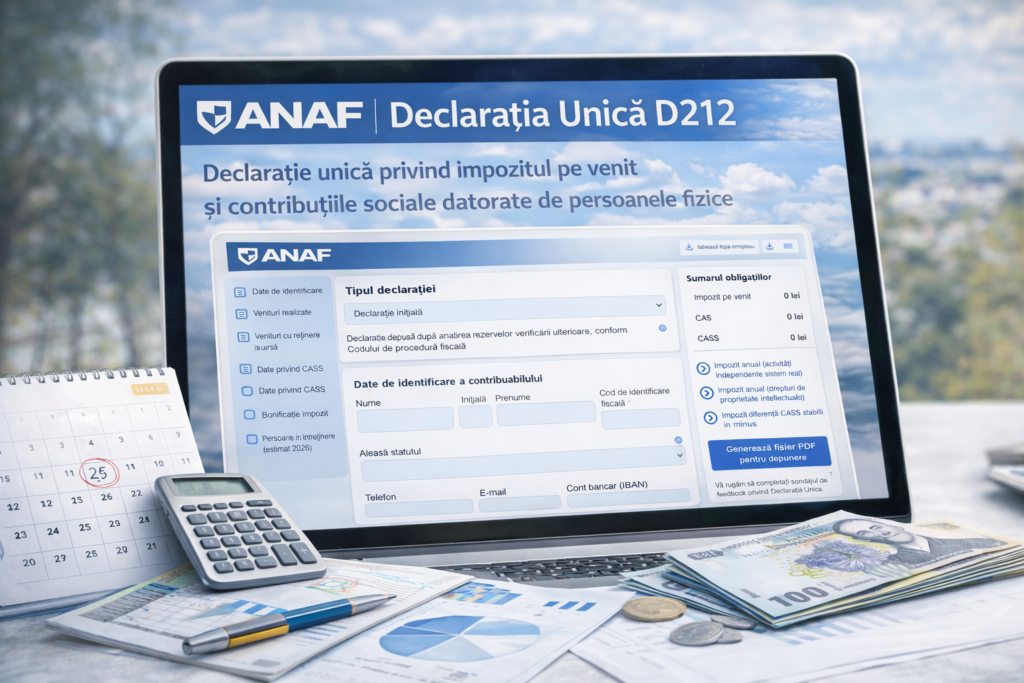
Starting in 2026, individuals may access a pre-filled version of the Single Tax Return (Form D212) through the ANAF platform. This initiative represents an important step in the digitalisation of the relationship between taxpayers and the tax authorities and reflects the authorities’ intention to simplify the reporting process.
However, beyond its obvious benefits, the use of this facility requires a proper understanding of how the data are generated, as well as of the system’s limitations.
Where and how the return can be accessed
The pre-filled Single Tax Return is available online via the Private Virtual Space (SPV). After authentication, the taxpayer accesses the section dedicated to filing tax returns and selects the form corresponding to the 2026 tax year.
By choosing the option to retrieve pre-filled data, the system generates a guided process in which the information identified by ANAF is displayed, together with the available options for including such information in the return.
What “pre-filled” actually means
Although the term may suggest full automation, in practice the mechanism functions as a support tool for the taxpayer. ANAF provides the information available in its databases, but the final decision on whether and how to use this information rests entirely with the taxpayer.
For each identified source of income, the taxpayer may:
- accept the available information, including amounts, where these exist;
- include the income source without completing the amounts;
- exclude the information entirely from the return.
For example, in the case of investment income reported by payers through informative tax returns, the system may display specific values. For other categories of income, however, the information may be limited to identifying the source, without financial details.
Where ANAF does not have sufficient data, the system explicitly indicates that the income cannot be determined automatically.
Sources of the pre-filled information
The data used to pre-fill the return result from the correlation of multiple sources available to the tax authorities. These include, among others:
- informative returns filed by income payers (such as Forms D205 and D112);
- Single Tax Returns previously filed by taxpayers (Form D212);
- returns relating to partnerships without legal personality (Form D204);
- records of rental agreements;
- the taxpayer registry.
The level of detail depends directly on the existence of third-party reporting. Where income is reported by third parties, the information is generally more comprehensive. In the absence of such reporting, the system provides only indications that an income-generating activity exists.
Impact on the reporting process
The main change lies in the fact that the return is no longer built entirely by the taxpayer from scratch. Instead, the process starts from data already available in the system, which changes the taxpayer’s role.
Rather than merely entering information, the taxpayer must review, correct and supplement the data, as necessary. The focus therefore shifts from technical data entry to substantive tax analysis.
At the same time, ANAF strengthens its verification capabilities by cross-checking information from multiple sources. This approach allows for quicker identification of inconsistencies and, implicitly, increases the pressure for accurate income reporting.
In the long term, the mechanism may contribute to better alignment of tax data and to reducing discrepancies between taxpayers’ declarations and those of income payers.
System limitations
In its current form, pre-filling does not cover all types of income.
For independent activities, for example, the system cannot determine the income earned or the tax base, limiting itself to identifying the existence of the activity. The tax computation remains entirely the taxpayer’s responsibility.
Similarly, income obtained abroad is not automatically included and must be reported manually, in the absence of a centralised reporting mechanism.
Another important aspect is the system’s reliance on the accuracy of third-party reporting. Any errors in informative returns will be directly reflected in the pre-filled form.
Finally, there is a risk that the displayed information may be perceived as implicitly correct. In reality, it merely reflects the data available in the system, which may be incomplete or inaccurate.
What taxpayers must do next
Pre-filling the return does not alter the underlying legal obligations. Taxpayers remain fully responsible for the content of the return they submit.
They must review each source of income, correct any inconsistencies and enter missing information. Where errors are identified after submission, a corrective return must be filed.
What the pre-filled return does not cover
Regardless of the level of detail displayed, entire categories of income fall outside the scope of automatic pre-filling and remain entirely the taxpayer’s responsibility. The most relevant example is income earned abroad — irrespective of its type (dividends, interest, rental income, investment gains or other sources). In the absence of a centralised cross-border reporting mechanism, ANAF does not have the underlying data and cannot populate these fields. The same limitation applies to independent activities, where the system identifies the existence of the activity but cannot calculate the net income or the basis for social contributions.
Beyond these excluded categories, practical experience shows that the most common difficulties arise at the analysis stage, not in the technical completion of the form itself. Incomplete identification of relevant income, incorrect assessment of social contribution thresholds (CAS/CASS), inconsistent tax treatment applied to similar income streams, or reliance on pre-filled data without proper validation are frequent issues that can lead to additional tax liabilities, subsequent amendments or exchanges with the tax authorities. The risk is particularly significant for taxpayers with multiple income sources, international structures or company participations — categories for which pre-filling provides, at best, a starting point.
How Nowium can assist you
Pre-filling is a welcome and useful step forward — but it does not replace the need for proper tax analysis. With over 20 years of experience advising individuals, including cases involving investments, foreign income and international mobility, the Nowium team can take over this analysis in full: verifying and validating the pre-filled data, identifying income streams not captured by the system, correctly determining the applicable tax liabilities, and preparing and filing the Annual Tax Return, including for complex situations. Involving a specialist does not make the process more complicated — on the contrary, it ensures that risks are properly managed and that the taxpayer has confidence that their tax position is accurately reflected. Given that requests tend to increase during this period, it is advisable to initiate such a review as early as possible.
Conclusion
The introduction of the pre-filled Single Tax Return represents a natural step in the modernisation of the tax administration. While the system brings increased efficiency and transparency, it does not eliminate the need for careful data review.
At this stage, pre-filling functions as a support tool rather than a complete solution. Its usefulness depends on the coverage of available data and on the taxpayer’s ability to interpret them correctly.
In this context, completing the return increasingly requires substantive tax analysis rather than a purely administrative exercise. Pre-filling is a useful tool that simplifies the process where data are available — but its coverage remains limited, and ultimate responsibility rests entirely with the taxpayer.
For taxpayers with multiple income sources, international activity or more complex structures, the difference between a correct return and one that carries risk depends, to a large extent, on the quality of the underlying tax analysis.
Article written by Radu Derscariu, Payroll Director– Nowium Tax&Finance
Access other articles published by Nowium in the section News.
Do you have a fiscal emergency and need support now?
Tell us in a message and we’ll get back to you shortly.