Newsletter no. 11 – November 2025

Access the magazine version of this Newsletter in pdf format: English or Romanian
Summary
- Procedures to apply special VAT exemption scheme for small enterprises, both for companies from Romania operating in other EU Member States, and for companies from other EU Member States operating in Romania (Order 2509/2025)
- Amendments on removal from the fiscal record (Law 179/2025)
- The new procedure for ex officio fiscal registration or upon request from another authority that manages tax receivables (Order 2430/2025)
- New measures to streamline the payment of contravention fines (Government Decision 923/2025)
- Creation of sole account to collect all contravention fines applied to individuals (Order 1823/2025)
- Closing exchange rates for November 2025
- Social indicators
Order 2509/2025 to approve Procedure for applying rules provided by art. 310^1 of the Fiscal Code, for taxable entities whose place of business is in Romania and which apply special VAT exemption scheme for small enterprises in other Member States, as well as the Procedure for applying special VAT exemption scheme for small enterprises applied in Romania by taxable entities whose place of business is in other Member States, as provided by art. 310^2 of the Fiscal Code, as well as template and content of certain forms (Official Gazette 1067/2025)
Summary
The Order regulates the procedures for applying special VAT exemption scheme for small enterprises, given the amendments introduced by Directive (EU) 2020/285.
Details
Specifically:
- for companies from Romania: it establishes the procedure through which taxable entities whose place of business is in Romania may apply special exemption scheme for small enterprises in other EU Member States (art. 310^1 of the Fiscal Code).
- for companies from other Member States: it regulates the procedure through which taxable entities established in another Member State may apply special exemption scheme for supplies/services carried out in Romania (art. 310^2 of the Fiscal Code).
- it includes templates and content of forms required (decisions, notifications, notices) for the administration of this scheme.
1. Procedure for taxable entities established in Romania and applying special exemption scheme in other Member States (art. 310^1 of the Fiscal Code)
The application of the scheme is carried out based on a prior notification sent electronically to the competent fiscal authority, which includes the identification data of the taxpayer, the Member States concerned, as well as the estimated values of the operations.
The notification may be updated whenever relevant changes occur, including for extending or ceasing the application of the scheme in the declared Member States.
The notification is subject to a decision of approval or rejection, communicated both to the taxpayer and to the Member States involved, through the European electronic administration system.
Taxpayers are required to comply with the annual threshold applicable to the exemption in the Member State concerned, which represents the value limit of exempt supplies of goods and/or services, the equivalent of EUR 100,000 per year, according to EU legislation.
Taxpayers are required to report periodically, generally quarterly, the total value of supplies and/or services performed in the Member States where the special scheme is applied, according to the European structure and format.
The values are reported in Euro, using the exchange rate in force on the first day of the calendar year. The conversion is carried out by applying the exchange rate published by the European Central Bank for that day or, if not published on that day, for the next publication day.
The application of the scheme may cease upon exceeding the threshold, failure to comply with legal conditions, or at the taxpayer’s request, and the cessation is communicated through a decision of the fiscal authorities notified to the Member States concerned.
The procedures are administered through a European electronic platform, and all forms and data are sent electronically through the National Centre for Financial Information system of the Ministry of Finance.
2. Procedure for taxable entities established in other Member States and applying special exemption scheme in Romania (art. 310^2 of the Fiscal Code)
The obligation to notify lies with the Member State where the taxpayer is established, which electronically transmits to ANAF the notification on the intention to apply the scheme in Romania, including information on the annual VAT exemption threshold, which in Romania is RON 395,000, and the classification of the taxpayer as a small enterprise.
ANAF verifies compliance with the conditions provided by domestic law and issues a decision of approval or rejection, communicated both to the taxpayer, through the Member State of establishment, and to the fiscal authorities of that state.
The non-resident taxpayer should comply with the annual threshold applicable in Romania and should report periodically the operations carried out on the territory of Romania, generally quarterly, according to standardised European format.
The application of the scheme may cease upon exceeding the threshold, loss of eligibility, or withdrawal of the notification by the Member State of establishment, and ANAF will issue a cessation decision communicated to the taxpayer and the fiscal authorities of the Member State.
Notifications and reporting
The Order approves the structure of prior notification on the application of special exemption scheme in other EU Member States, through which taxable entities from Romania fulfil the declarative obligations provided by art. 310^1 of the Fiscal Code. Additionally, the structure of the Report on total value of supplies and/or services carried out by taxable entities applying the scheme in other Member States has been established, a report which covers the obligations declared by art. 310^1 of the Fiscal Code.
For the application of special exemption scheme in Romania by taxable entities established in other Member States, according to art. 310^2 of the Fiscal Code, the template of the decision through which the fiscal authority communicates either the rejection of the request to apply the scheme or its cessation on Romanian territory has also been approved.

Law 179/2025 to amend art. 6 para. (1) letter h) of the Government Ordinance 39/2015 on the fiscal record (Official Gazette 1025/2025)
Summary
The Law amends the rule regarding the date when a taxpayer declared inactive and subsequently reactivated is removed from the fiscal record.
Details
The new rule introduced by the Law provides the following:
1. If the taxpayer was declared inactive for reasons provided by art. 92 para. (1) letters a), e)–g) of the Fiscal Procedure Code, then:
- date of removal from the fiscal record is the very date of reactivation.
2. If the inactivity was established for reasons provided by art. 92 para. (1) letters b) and c) (e.g., registered headquarters declared fictitious, absence of statutory bodies registered with the Trade Register):
- removal from the fiscal record takes place three months after the date of reactivation.
3. The rule applies not only to the taxpayer but also to legal representatives or designated representatives (who assume fiscal liability).
In conclusion, Law 179/2025 clarifies the moment of removal from the fiscal record after the reactivation of a taxpayer, differentiating between the causes of inactivity and introducing a three-month period for certain more serious situations.
Order 2430/2025 to approve Procedure for ex officio fiscal registration or upon request from another authority that manages tax receivables, of a fiscal subject that has not fulfilled its fiscal registration obligation according to law (Official Gazette 1023/2025)
Summary
The Order approves new procedure for ex officio fiscal registration or upon request from another authority that manages tax receivables, of a fiscal subject that has not fulfilled the fiscal registration obligation.
Details
We note the main changes introduced:
- Clarification on duties of the competent central fiscal authority depending on the type of taxpayer (including individuals carrying out independent economic activities or liberal professions);
- Introduction of the obligation of local authorities to send notifications regarding non-resident taxpayers owning goods/land/means of transport in Romania for the purpose of fiscal registration;
- Setting procedures for fiscal registration upon request of other authorities managing tax receivables, with specific documentation;
- Clarifications on the procedure to notify, hear, issue the report, issue and communicate the decision, including time limits and specific archiving of documents.
Initiating ex officio fiscal registration procedure by ANAF requires prior notification of the taxpayers concerned. By exception, the notification is not issued:
1. in the case of requests submitted by the fiscal inspection authorities, based on the findings included in administrative fiscal acts that have become final due to failure to exercise the legal remedies provided by law or by a final court ruling;
2. or in the case where the taxpayer’s fiscal registration is based on final court rulings.
Through the notification, taxpayers benefit from the right to be heard prior to having the registration carried out.
Subsequent to receiving the notification, taxpayers have a period of 5 days to participate in a hearing and to prove that they do not have the obligation to be fiscally registered. For taxpayers which, following the notification, have explicitly refused to appear on the date set by fiscal authority, by submitting in writing a waiver of their right to be heard, the hearing is deemed to have been carried out. However, the fiscal authorities send a second notification, thus offering a new opportunity to exercise the right to be heard, in situations where:
- taxpayers have not filed the fiscal registration declaration;
- taxpayers have not exercised their right to be heard in the hearing procedure;
- taxpayers have not explicitly refused to appear on the date set by the fiscal authority for the hearing.
If, following the notification, taxpayers acknowledge the obligation and submit the fiscal registration declaration on their own initiative, they avoid the continuation of ex officio procedure.
In the absence of a response from the taxpayer or in cases where, during the hearing, no clear arguments are presented to justify the lack of registration, ANAF will continue the procedure and will finalize the fiscal registration. In this case, the fiscal registration decision is issued and communicated to the taxpayer, together with the fiscal registration certificate. At the same time with the ex officio fiscal registration of the taxpayer, the sanctions for failing to submit the fiscal registration declaration within the deadlines provided by law also apply, in accordance with the legal provisions in force.
Decision 923/2025 to approve Application Norms of provisions of Law 203/2018 on measures to streamline the payment of contravention fines (Official Gazette 1014/2025)
Summary
The Decision approves Application Norms for provisions of Law 203/2018 on measures to streamline the payment of contravention fines.
The norms apply, in a pilot system, to contravention fines for traffic violations on public roads imposed on motor vehicle drivers.
Details
The Norms detail:
- the manner of issuing and transmitting electronic debt instruments;
- the payment procedures into sole fines account;
- the IT flows between authorities (the Ministry of Internal Affairs “MIA” – the Ministry of Finance “MF” – the Territorial Administrative Units “TAUs”);
- the use of the unique registration series of the minutes of findings.
Main provisions
1. Electronic debt instruments
They are issued by authorities that have implemented:
- the unique registration series
- the electronic transmission of data to the Ministry of Finance (“MF”).
These instruments are sent daily to MF, which subsequently redistributes them to local fiscal authorities or to fiscal administration for non-residents.
2. Methods to pay fines
Fines are paid exclusively into the sole account (50.09.01 or RO76TREZ999500901XXXXXXX – IBAN), through:
- bank transfer, internet banking, mobile banking;
- through MF transitional account opened at commercial banks;
- in cash or via POS at the State Treasury;
- in cash at local fiscal office cashiers;
- card payments through ghiseul.ro;
- POS terminals at local fiscal authorities’ offices.
The payment may be made by the offender or by any other individual.
3. Rules on filling payment documents
The documents should mandatorily include:
- the unique registration series of the minutes of findings (under “Payment registration number”);
- the offender’s personal numeric code (CNP) or the generic code 8609468 for individuals without a CNP;
- the sole account;
- the amount and date of payment.
The Ministry of Finance may refund the amounts if essential data are incorrectly completed (incorrect CNP, missing series, etc.).
4. Distribution of collected amounts
MF transfers the amounts:
- to the TAU of the offender’s domicile (for individuals domiciled in Romania)
- to the State Budget (for non-residents or individuals with unknown domicile).
The deadline is maximum 2 working days from collection.
5. Role of local fiscal authorities
After receiving the information from MF, the local fiscal authority:
- registers debt instruments;
- registers and settles payments in the fiscal records;
- initiates enforcement procedure for instruments that have become enforceable and remain unpaid;
- manages situations where the offender has changed domicile or made the payment to another TAU.
6. Content of the minutes of findings
The minutes:
- include all mandatory information provided by GO 2/2001;
- include elements to facilitate payment (QR code, barcode, etc.);
- may organise the information into separate sections for clarity.
In conclusion, the decision implements an essential technical reform of the mechanism for payment, recording and distribution of contravention fines, through:
- full digitalization of flows;
- unification of payments into a sole account;
- automation of the transmission and tracking of debt instruments;
- standardization of the minutes of findings through a national unique series;
- establishment of a clear flow between MIA, MF and local authorities.
The system initially applies in pilot mode to traffic fines issued by MIA.
Order 1823/2025 on the opening of the sole account for payment of contravention fines applied to individuals according to Law 203/2018 on measures to streamline the payment of contravention fines (Official Gazette 1043/2025)
Summary
The Order regulates the opening and use of the sole account 50.09.01 for the collection of all contravention fines applied to individuals within the system provided by Law 203/2018.
This sole account operates at:
- Central Operational Treasury
- territorial units of the State Treasury
Details
The account is used for collecting fines applied by agents of the authorities that issue electronic debt instruments (those that have implemented unique registration series and electronic transmission of data).
The account 50.09.01 is opened with different fiscal codes depending on who collects the amount:
a) At the Central Operational Treasury – with the fiscal identification code of the State Treasury
For amounts paid:
- by bank transfer or through MF transitional account,
- by postal order,
- by amounts transferred by territorial Treasury units (cash or POS),
- by amounts transferred by TAUs for individuals without domicile within their jurisdiction
b) At the territorial units of the State Treasury – with the fiscal identification code of the State Treasury
For amounts collected directly at the Treasury counters:
- in cash
- via POS
c) At the territorial units of the State Treasury – with the fiscal identification code of the TAU
For amounts collected directly by the TAU (municipalities), through:
- cashiers,
- ro,
- POS or electronic applications
Transfer of locally collected amounts
The territorial units of the Treasury transfer to the Central Operational Treasury the amounts collected according to point b).
Distribution of collected amounts
The amounts that reach MF’s sole account are redistributed as follows:
a) For individuals domiciled in Romania
To local budget of the TAU of the offender’s domicile, into account 21.A.35.01.02 “Revenues from fines and other sanctions applied by other specialised institutions”.
b) For individuals without domicile in Romania or with unknown domicile
To the State Budget, into account 20.A.35.01.03 “Revenues from fines applied to non-resident individuals”, opened at ATCP Bucharest.
Conclusion
Order 1823/2025:
- establishes the new sole account 50.09.01 for all electronically managed contravention fines applied to individuals,
- sets the manner of fiscal coding of the account depending on the institution collecting the amounts,
- regulates the flow of distribution of the amounts to local budgets or to the State Budget,
- defines the nationally used IBAN structure,
- updates practice by repealing the previous order from 2018.
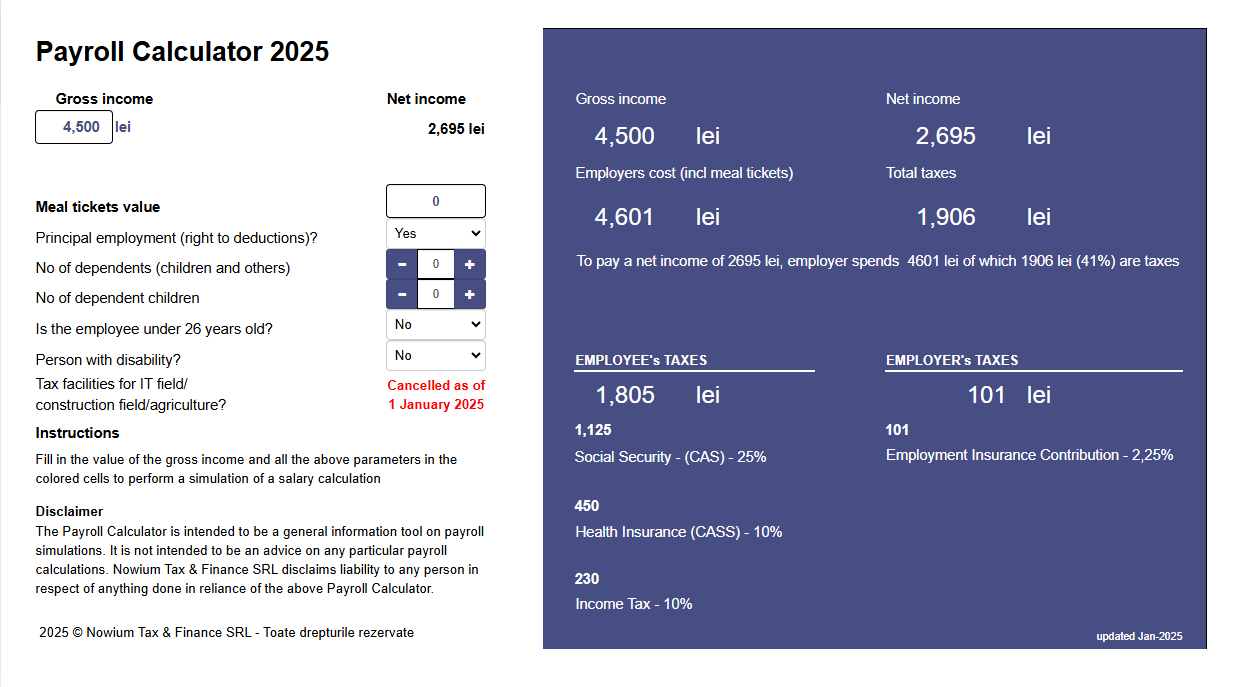
Check out our Payroll Calculator Tool on Nowium’s website
An useful free tool allowing various salary calculation scenarios, updated with the latest legislative changes. https://nowium.com/en/payroll-calculator/
Closing exchange rates for November 2025
The November 2025 closing NBR exchange rates to use for valuation of monetary items (cash on hand, receivables, payables) denominated in foreign currency, as well as receivables and payables denominated in RON but pegged to a foreign currency for collection/disbursement are:
1 EUR = 5,0906 RON; 1 USD = 4,4036 RON; 1 CHF = 5,4594 RON; 1 GBP = 5,8158 RON
The Resources section of our website has an Excel file through which exchange rates are automatically taken from the NBR website and are allocated on each date of validity, according to accounting rules. Thus, the exchange rate communicated by NBR on day N will be displayed on the validity dates N+1…N+2….until the next foreign exchange session.
The closing exchange rate for the month is the exchange rate communicated in the final foreign exchange session of the respective month.
Social Indicators 2025
2025 Contributions - for dependent activities | Employer and beneficiary (for activities considered dependent) | Employee and dependent worker |
Social security contribution (pension) | - Nothing due for normal working conditions | 25% |
Contribution to health insurance fund (calculated on gross income) | Not due | 10% |
Income Tax | 10% | |
Work insurance contribution | 2,25% | |
Disability Fund (for employers with more than 50 employees) | 4 x minimum wage for every 100 employees | |
The amount of a taxable meal ticket in the sense of income tax | max. RON 40.04 | |
Minimum wage (gross) | -> RON 4.050 (starting with January 2025 related income) -> RON 4.582 for employees from construction sector -> RON 4.050 for agriculture and food industry sectors (starting with January 2025 related income) | |
Per Diem (in the country) | 23 lei 57.5 lei | |
The tax facilities granted to employees working in the IT sector, construction, agriculture and the food industry have been eliminated starting with the income related to January 2025. | ||