Newsletter no. 12 – December 2025

Access the magazine version of this Newsletter in pdf format: English or Romanian
Summary
- The second package of fiscal measures has been published (Law 239/2025) and already amended (GEO 78/2025)
- The “train” Ordinance specific to the end of year introduces new fiscal changes (GEO 89/2025)
- Updates on excise duties and suspension of sanctions for failure to include the QR code on the fiscal receipt (GEO 68/2025)
- New annual reporting obligations to ANAF targeting crypto-asset service providers (GEO 71/2025)
- The new Sole Tax Return to be used for 2025 (Order 2736/2025)
- Update of VAT registration procedures (Order 2633/2025)
- Updated values for meal tickets and nursery vouchers (Law 201/2025)
- Amendments to legislation on internships (Law 209/2025)
- Other fiscal updates
- 2025 closing exchange rates
- Social indicators
Nowium Audit & Assurance
Nowium expands its service portfolio by launching its Audit & Assurance division, dedicated to companies that require certainty, rigor, and clarity in financial reporting. We provide financial audit and internal audit services, carried out in accordance with applicable professional standards, with a focus on credibility of financial information and risk management.
Through this new division, we support management and shareholders in making well-informed decisions in an increasingly complex economic and legislative environment.
👉 Discover Nowium Audit & Assurance services:
Law 239/2025 to set certain measures for recovery and efficiency of public resources and to amend and complement certain normative acts (Official Gazette 1160/2025)
Summary
The Law, known as “Package 2” of legislative measures, initiated as early as August, was adopted during December after passing the review of the Constitutional Court. However, shortly thereafter, amendments were introduced through GEO 78/2025, presented below.
Details
Below we present the main novelties and amendments introduced by Package 2 of fiscal measures.
CORPORATE INCOME TAX
Limitation to 1% of deductibility of expenses related to intellectual property rights, management and consultancy services
(Later edit: the limitation was subsequently repealed by Government Ordinance 6/2026, which stated that “For corporate income tax payers, the expenses that fell under the scope of Article 251 of the Fiscal Code shall follow the deductibility rules set out in Article 25 of the Fiscal Code for determining the fiscal result starting with the first quarter of 2026, or for determining the fiscal result for the year 2026 in the case of taxpayers applying the annual corporate income tax reporting and payment system.”)
Taxpayers whose turnover in the previous year is less than or equal to EUR 50 million (therefore those not applying the minimum turnover tax – IMCA) consider deductible the expenses related to intellectual property rights, management and consultancy services, incurred in relation to affiliated entities that are not established or incorporated in Romania and do not have their place of effective management on the territory of Romania, within the limit of 1% of total recorded expenses.
Exceptions! Expenses related to intellectual property rights, management and consultancy, resulting from transactions with affiliated entities that are not established/incorporated and do not have their place of effective management in Romania, which are capitalized in the value of tangible and intangible fixed assets, as well as those incurred for obtaining trademarks, industrial designs and models, copyrights and similar rights, registered in Romania.
How to calculate the limitation
- The percentage of these expenses in total expenses is calculated for the year 2024, considered the reference year;
- The excepted expenses mentioned above are not taken into account when determining the share;
- If the percentage for the year 2024 exceeds 1%, then in 2026 the deductibility of these expenses will be limited to 1% of total expenses.
Which taxpayers do not apply the limitation
- taxpayers that are non-profit organizations (NGOs, trade unions, etc.) – as defined by art. 15 of the Fiscal Code;
- taxpayers subject to IMCA, namely those with revenues exceeding EUR 50 million;
- credit institutions, namely Romanian legal entities and Romanian branches of foreign credit institutions;
- taxpayers holding an advance pricing agreement.
Taxpayers that were set-up during a fiscal year apply the provisions, for the fiscal year of set-up, at the end of the fiscal year of calculation, based on the accounting records related to that year. Moreover, the provisions also apply to taxpayers that were set-up during the year 2025/modified fiscal year starting in 2025, in order to determine the fiscal result of the fiscal year 2026/the modified fiscal year starting in 2026.
The above-mentioned provisions also apply to the fiscal group, being applied accordingly by its members, depending on their individual situation.
Starting with fiscal year 2027, for the purpose of limiting deductibility, expenses in relation to affiliated entities as defined according to fiscal regulations will be taken into account, their value to be declared in a special tax return to be approved by ANAF Order. Furthermore, if an advance pricing agreement is requested in 2027 for these expenses, the deductibility limitation will not apply starting from the date of submission of the request to issue the advance pricing agreement; however, if the request is rejected, the tax should be recalculated retroactively and paid to the state together with related additional taxes.
If the 1% deductibility limitation is applied, other deductibility rules provided by art. 25 of the Fiscal Code no longer apply.
SPECIFIC TAX ON TURNOVER (ICAS)
Clarifications are introduced on deduction of the value of assets in progress/assets according to indicators I and A from the specific tax on turnover (ICAS) for Romanian and foreign legal entities carrying out activities in oil and natural gas sectors.
The assets in progress/assets that have been deducted should be retained in the patrimony for at least half of their economic useful life, but no longer than five years. If this condition is not met, the tax is recalculated for those amounts and ancillary tax liabilities are charged from the quarter/year in which the deduction was made by the 31st of December 2025/the last day of the modified fiscal year ending in 2026. Certain exceptions to this rule are also provided.
INCOME TAX
Income from independent activities
Starting with income earned in 2026, income obtained from provision of accommodation services and short-term rental of more than seven rooms located in personally owned dwellings is included in the category of income from independent activities. For this income, the tax is determined by applying the 10% rate to annual net income calculated by deducting from gross income the expenses determined by applying the flat-rate percentage of 30% to gross income.
By including this income in the category of income from independent activities, it will also be subject to social insurance contributions (CAS) and health insurance contributions (CASS) according to rules applicable to this category.
Social contributions – annual ceiling for calculating health insurance contribution for individuals earning income classified as income from independent activities increases from 60 gross minimum wages per country to 72 gross minimum wages per country. The new ceiling applies starting with income earned in 2026.
For income from independent activities earned in fiscal year 2025, the tax obligations regarding the health insurance contribution are those in force on the date when the income is earned.
Income quotas
A new method is provided to determine the minimum level of income quotas for income obtained from independent activities. The minimum level of income quotas is determined by reference to the level of 12 gross minimum base wages per country guaranteed for payment, in force on the 1st of January of the year in which the income is earned (instead of the gross minimum base wage per country guaranteed for payment in force at the time the quota is established), multiplied by 12.
Income from rental activities
Included in this category is the income obtained from short-term rental of up to seven rooms located in personally owned dwellings (previously, the limit was 5 rooms). The annual net income is determined by deducting from the gross income the expenses calculated by applying the flat-rate percentage of 30% to the gross income.
Exception: For income from independent activities/income from rental activities obtained in 2025 from rental by owners of rooms located in personally owned dwellings for tourist purposes, other than those representing tourist accommodation structures, according to specific legislation, for which the determination of net income was made based on income quotas or real system, the tax obligations are those in force in the year when the income is obtained. The fiscal loss recorded in fiscal year 2025 represents a final loss of the taxpayer.
Income from investments
Starting the 1st of January 2026, the tax on gains from the transfer of securities and from transactions with derivative financial instruments carried out through resident intermediaries (brokers registered in Romania) is increased as follows:
- For securities and derivative instruments held/traded for a period of ≥ 365 days from the acquisition date, the tax rate increases from 1% to 3%.
- For those held/traded for < 365 days, the tax rate increases from 3% to 6%.
The tax on gains from the transfer of securities/derivative financial instruments (other than those carried out through resident intermediaries) and from the transfer of investment gold is increased from 10% to 16%. This measure applies starting with income earned in 2026.
The tax on gains from the transfer of virtual currency is increased from 10% to 16%. This measure applies to gains obtained starting the 1st of January 2026. Gains below RON 200 per transaction are not taxed, provided that the total gains in a fiscal year do not exceed RON 600.
SPECIAL TAX ON HIGH-VALUE IMMOVABLE AND MOVABLE ASSETS
The special tax on high-value immovable and movable assets is increased from 0.3% to 0.9%, starting the 1st of January 2026.
We recall that this tax is due by:
- individuals who, on the 31st of December of the previous fiscal year, own/jointly own residential buildings located in Romania whose taxable value exceeds RON 2,500,000. Taxpayers liable for tax on building for which local tax authority has determined a taxable value higher than RON 2,500,000 are notified by that authority by the 30th of May of the year for which the special tax on high-value immovable and movable assets is due;
- individuals and legal entities that own motor vehicles registered/recorded in Romania whose individual acquisition value exceeds RON 375,000. The tax is due for a period of 5 years starting with the fiscal year in which the handover of the vehicle takes place or for the remaining fraction of years until the completion of the 5-year period from that date for vehicles for which the handover took place earlier.
LOCAL TAXES
Tax on building
Certain exemptions are repealed, such as those applicable to buildings owned by foundations established through will or to buildings belonging to an institution or unit operating under the coordination of certain ministries. The 50% reduction of the tax on building for buildings owned by individuals and legal entities that are used for the provision of tourist services for a period of up to 180 consecutive or cumulative days during a calendar year is eliminated.
The regulations that allowed local councils to grant discounts for tax on building for individuals who:
- prove at least three blood donations during a calendar year,
- are disabled persons,
are repealed.
The article allowing the application of a fixed rate of 0.4% on the taxable value of non-residential buildings owned by individuals and used for agricultural activities is repealed.
At the same time, new exemptions are introduced, such as those for new buildings from investment projects in the manufacturing/warehousing/logistics industry, which may benefit from an exemption from tax on building for a period of two years calculated from the moment of receipt of the construction, starting the 1st of January of the year following the year when the receipt took place.
In the case of residential buildings affected by natural disasters, the exemption will apply only for two years (previously five years), and for buildings where sports activities are carried out and for greenhouses/vegetable solariums/silos – the reduction is up to 50% of the tax amount (previously they were exempt).
For residential buildings owned by individuals, the taxable value per square meter is increased and the discounts are eliminated. The tax rate on residential/non-residential buildings owned by individuals may not be lower than that established for 2025.
For legal entities, the provisions regarding residential buildings and mixed-use buildings were initially eliminated, leaving only those related to non-residential buildings, but this provision was subsequently postponed by the 1st of January 2027 (through GEO 78/2025, see below).
The tax on residential buildings owned by individuals is significantly increased.
Tax on land
Certain exemptions are removed and others are added, in correlation with those applicable to tax on building.
The taxable value per hectare is increased for land located outside the built-up area and within the built-up area, recorded in the agricultural register under a land-use category other than land with constructions.
Exemptions are eliminated for degraded/polluted land, land unsuitable for agriculture or forestry, and land owned by disabled persons.
Local councils may no longer grant exemptions or discounts for land belonging to special categories.
As in the case of buildings, exemptions are introduced for land related to new buildings from investment projects. The exemption is granted for a period of two years calculated from the moment of receipt of the construction, starting the 1st of January of the year following the year when the receipt took place.
Other exemptions/discounts:
- for land registered in the land registry at the owner’s own expense – the exemption is granted for a period of two years (previously, five years of exemption only for land located outside the built-up area); land belonging to national minorities, which may benefit from exemptions or discounts established by local councils (previously exempt).
The provisions under which local councils could grant discounts for tax on land for individuals who:
- prove at least three blood donations during a calendar year,
- are disabled persons,
are repealed.
The paragraph granting a 50% discount of tax on land for land owned by individuals and legal entities and used for the provision of tourist services for a period of up to 180 consecutive or cumulative days during a calendar year is repealed.
As in the case of buildings, the amount of tax is significantly increased for land located outside the built-up area and within the built-up area without constructions.
Tax on means of transportation
Certain exemptions are eliminated:
- for means of transportation used exclusively for interventions in emergency situations
- for river passenger vessels, boats and skiffs used for the transportation of individuals domiciled in certain regions of the country, as provided by law;
- for means of transportation belonging to institutions or units operating under the coordination of certain ministries.
Also, new situations are introduced when local councils and the General Council of the Municipality of Bucharest may decide to grant exemptions or discounts for tax on means of transportation.
For registered vehicles, the method of calculating the tax is amended, so that it is calculated based on engine capacity and pollution standard, by multiplying each group of 200 cm³ or fraction thereof by the corresponding amount provided by law. The relevant ministries will cooperate in the exchange of data regarding the pollution standard.
For hybrid vehicles with CO₂ emissions less than or equal to 50 g/km, the tax is reduced by up to 30%, according to the decision of the local council/the General Council of the Municipality of Bucharest.
For electrically powered vehicles, the tax on means of transportation is a fixed amount of RON 40 per year.
OTHER TAXES
Starting the 1st of January 2026, a logistics tax of RON 25 is introduced for each parcel containing goods with a declared commercial value below EUR 150, originating from outside the European Union and entering the territory of Romania, regardless of the place of release for free circulation within the EU. The tax applies to all extra-EU parcels whose starting point of delivery is outside the European Union and which meet the conditions provided by law.
The tax applies to parcels containing goods delivered in the context of distance sales of products imported from states or territories outside the European Union.
The responsibility to pay the tax lies with the supplier of the goods, the sender, or the digital platform facilitating the distance sale, depending on the specific situation.
The collection, declaration, and remittance of the tax are the responsibility of postal service providers.
The amounts collected should be transferred to the state budget by the 25th day of the month following that in which the parcel was handed over to the recipient.
FISCAL PROCEDURE CODE
FISCAL RISK
New general criteria are introduced based on which the fiscal risk class/subclass is determined:
- the use of non-cash payment instruments;
- early warning regarding financial capacity to pay tax obligations;
- information on facts recorded in the fiscal record.
OBLIGATION TO HOLD A BANK ACCOUNT IN ROMANIA
An obligation is introduced for legal entities to hold a bank account.
Legal entities are required to hold a payment account in Romania or an account opened with the State Treasury for the entire duration of their activity. Newly established legal entities have 60 working days to open the account.
FISCAL INACTIVITY
New situations of inactivity are defined for the taxpayer/payer:
- Does not have a payment account in Romania or an account opened with a State Treasury unit;
- Has not submitted the annual financial statements within five months from the legal deadline for their submission.
The taxpayer/payer declared inactive in the cases described above is reactivated if:
- it is no longer in the situation that generated the inactivity;
- all declarative obligations provided by law are fulfilled;
- it does not register outstanding tax obligations;
- it is not in any other situation of inactivity among those provided by art. 92 para. (1), letters d)–g) of the Fiscal Procedure Code.
New cases of dissolution of the inactive taxpayer/payer have been introduced, upon request filed by ANAF. Thus, taxpayers declared inactive without outstanding tax obligations/other budgetary claims individualized in enforceable titles/without criminal complaints and which, on the 18th of December 2025, have:
- between 1 and 3 years of inactivity – are dissolved if they do not reactivate within 90 days from that date;
- more than 3 years of inactivity – are dissolved if they do not reactivate within 30 days from that date.
Exception: in the case of temporary inactivity registered with the Trade Registry, dissolution is carried out if the activity is not resumed after the expiration date of the inactivity period.
In the case of taxpayers declared inactive prior to the 18th of December 2025, that appear with outstanding tax obligations and other budgetary claims individualized in enforceable titles and are not subject to criminal complaints, ANAF is obliged to file the request for dissolution within one year from the date of entry into force of the law, if they do not reactivate.
RESCHEDULED/INSTALMENT PAYMENTS
Amendments are introduced to rescheduled/instalment payments mechanism, including the obligation to submit a surety agreement. Thus, in order to obtain, maintain, or amend a rescheduled/instalment payment, debtors should submit a surety agreement.
For legal entities, the surety agreement should be concluded in authentic form with the beneficial owner(s) of the debtor.
For individuals, the surety agreement should be concluded based on the provisions of the Civil Code, which means that the guarantor should be a person capable of assuming obligations, who owns and maintains sufficient assets in Romania to satisfy the claim and who is domiciled in Romania. If any of these conditions is not met, the debtor should present another guarantor.
Public institutions, autonomous public authorities/services, as well as debtor legal entities in which the state or an administrative-territorial unit/subdivision is the majority shareholder are exempt from this rule.
The surety agreement is a personal guarantee by which the beneficial owner(s) undertake to pay instead of the debtor if the debtor fails to fulfil its tax obligations and constitutes an enforceable title. It should be submitted:
- within 30 days from the date of communication of the agreement in principle, if the debtor should pay tax obligations administered by the tax authority that are not subject to the payment rescheduling, with certain exceptions specifically provided by law, or if it is a legal entity established less than 12 months prior to the submission of the rescheduling request;
- within 5 days from the date of communication of the fiscal attestation certificate, if the debtor does not own assets for the purpose of establishing guarantees or such assets are insufficient;
- by the due date/payment deadline provided by law for current tax obligations administered by the tax authority that should be paid in order to maintain the rescheduling;
- within 10 days from the date of communication of the agreement in principle, if the debtor has requested the amendment of the payment rescheduling decision;
- by the date of submission of the request to maintain the validity of the payment rescheduling.
Also, the conditions for granting such rescheduling are tightened.
New provisions on payment rescheduling apply only to applications approved, enforcement notices communicated, or applications submitted starting the 18th of December 2025. For requests for granting classic payment rescheduling/amending the rescheduling decision/maintaining the validity of the rescheduling submitted and not solved by the 18th of December 2025, the debtor should submit the surety agreement within 30 days from that date.
The new conditions on payment rescheduling (the condition to settle previous rescheduling, maximum thresholds for debts, exceptions for debts below minimum thresholds, the new condition for legal entities, etc.) enter into force 30 days from the date of entry into force of the law.
SIMPLIFIED RESCHEDULED PAYMENT
A series of important amendments have been introduced to the procedure for simplified rescheduled payment of tax obligations.
Condition to settle previous rescheduled payment
Debtors should settle debts arising from previous simplified rescheduled payments or from those granted according to GEO 181/2020, including those on which the maintenance of the validity of such rescheduled payment depended, prior to requesting a new rescheduling. Fiscal discipline is thus strengthened and the accumulation of debts through multiple successive rescheduled payments is prevented.
Maximum thresholds for debts:
- Individuals: RON 500 – RON 100,000;
- Associations without legal personality: RON 2,000 – RON 100,000;
- Legal entities: RON 5,000 – RON 400,000.
This amendment aims to reduce the scope of simplified rescheduled payment by establishing upper thresholds for tax obligations that may be rescheduled under this procedure.
Exception for debts below the minimum thresholds – even if the debts do not reach the maximum thresholds, payment rescheduling may be granted if the debtor has to recover certain and liquid amounts from public authorities or institutions, within the limit of those amounts and based on a document certifying them, except for amounts subject to litigation pending before the courts.
New condition for legal entities – companies should have at least 12 months from set-up in order to submit the request.
LAW ON COMPANIES
Increase of share capital for limited liability companies (SRL)
The share capital of a limited liability company shall be determined depending on the level of net turnover resulting from the annual financial statements of the previous financial year. The following minimum thresholds are established:
- RON 500 – for newly set-up companies and for those with an annual net turnover of up to RON 400,000;
- RON 5,000 – for companies with an annual net turnover exceeding RON 400,000.
Companies are required to increase their share capital by the end of the financial year following the year in which the increase of the net turnover above the minimum threshold is recorded.
In the event of a decrease in the net turnover, the value of the share capital remains unchanged, except where the SRL is transformed into a company of another legal form.
Failure to comply with the minimum share capital limits entitles any interested person and the National Trade Register Office may request in court the dissolution of the company. The company shall not be dissolved if, by the time the court decision on dissolution becomes final, the share capital is increased to the statutory minimum.
SRLs registered with the Trade Register are required to increase their share capital by amending the articles of incorporation within a maximum period of two years from the entry into force of Law 239/2025.
Increasing the share capital by the 31st of December 2026 ensures a 50% discount of the publication fee in the Official Gazette (only if the amendment concerns exclusively the increase of the share capital).
Sanctions and prohibitions for companies whose net assets are lower than half of the subscribed share capital
The following prohibitions are introduced for companies whose net assets fall below the statutory limit, namely where the net assets, calculated as the difference between total assets and total liabilities, represent less than half of the subscribed share capital:
a) prohibition to reimburse shareholders/associates or other affiliated entities loans granted by them;
b) prohibition to distribute dividends.
The sanctions are detailed below:
a) failure to comply with the obligation to restore net assets
A fine ranging from RON 10,000 to RON 200,000 applies if the net assets are not restored to a level at least equal to half of the share capital, no later than the end of the financial year following the year when the losses were identified. For example, if as of the 31st of December 2025 the company’s net assets are lower than half of the share capital, with the finding made in 2026 upon preparation of the 2025 financial statements, the company is required to restore the net assets to at least half of the share capital by the 31st of December 2027. Otherwise, a fine between RON 10,000 and RON 200,000 applies.
Companies that record liabilities towards shareholders arising from loans or other financing granted by them and that fail to comply with the obligation to restore net assets within two years from the end of the financial year following the one when the losses were identified are required to increase the share capital by converting these receivables, while respecting the rights of the other shareholders. Failure to comply with this obligation is sanctioned with a fine ranging from RON 40,000 to RON 300,000.
These provisions apply starting with the annual financial statements related to the financial year beginning on the 1st of January 2025 or thereafter, with the exception of companies declared temporarily inactive with the Trade Register. Sanctions are applied by ANAF, and, as an exception from GO 2/2001, the statute of limitations for applying sanctions is 12 months from the date of the offence, instead of 6 months.
They do not apply to shareholders/associates who:
- have as their purpose or object of activity investing or managing alternative investment funds or eligible venture capital funds and are entities belonging to alternative investment fund groups or eligible venture capital fund groups, or are managers of such funds;
- have as their main purpose or object of activity investing, holding participations in companies or the professional financing of companies in which they hold shares/participations (CAEN 64);
- qualify as professional investors;
- qualify as investors in a crowdfunding project, either directly or indirectly, through an entity that directly holds a participation in such a project; or
- are individuals who have invested an amount between EUR 2,500 and EUR 200,000 in a microenterprise or small enterprise and do not hold, directly or indirectly, more than 25% of the share capital of that company, provided that, in any of the above situations, the loans are not repaid to shareholders/associates within a period of 4 years from the date the loans were granted.
For companies where the state or administrative-territorial units are shareholders, the liabilities to be converted into share capital do not include liabilities towards the general consolidated budget and loans received from proceeds of privatization.
b) prohibition to reimburse shareholders/associates or other affiliated entities for loans granted by them;
Breach of this prohibition constitutes a contravention and is sanctioned with a fine ranging from RON 10,000 to RON 200,000. In addition, joint and several liability of the company and the shareholder/associate to whom the loans were repaid is established, where the company’s net assets were below the statutory threshold, for outstanding budgetary obligations owed by the company and administered by the central tax authority, up to the amount of the loan granted and repaid.
This measure applies from the date of publication of the law: the 18th of December 2025.
c) prohibition to distribute dividends.
Dividend distributions may not be carried out until the net assets are restored to the minimum value provided by law. The prohibition also applies to interim dividend distributions in the case of companies which, based on interim financial statements, have net assets reduced to less than half of the subscribed share capital.
We recall that the receipt or payment of dividends, in any form, from fictitious profits or profits that could not be distributed during the financial year based on interim/annual financial statements, or contrary to those resulting from such statements, is punishable with prison from 1 to 5 years.
The company does not benefit from the possibility to pay half of the minimum fines mentioned above within 15 days from communication date of the notification/finding report.
This measure applies from the date of publication of the law: the 18th of December 2025.
New rules on the transfer of shares within limited liability companies
The additional formalities introduced for implementing transfers of shares within limited liability companies concern both the effects of the share transfer operation and the registration procedure.
According to new rules, the transfer of shares carried out by the shareholder holding control of the company becomes enforceable against the tax authority after the completion of the following steps:
- within 15 days from transfer date, the transferor, the transferee or the company notifies the central tax authority regarding the act on transfer of shares and the updated articles of incorporation containing identification data of new shareholders.
- if the company records outstanding tax liabilities, the company or transferee provides guarantees according to the Fiscal Procedure Code, which should be confirmed by the tax authority (cash deposits with a State Treasury unit or a guarantee letter issued by a credit institution or an insurance guarantee policy issued by an insurance company). The guarantees are released upon settlement of the tax liabilities or are enforced by the tax authority if the liabilities are not settled within 60 days from the date of registration of the transfer with the Trade Register.
The amendments to Law on Companies (minimum share capital value, transfer of shares) apply from the date of entry into force of the law, the 18th of December 2025. The law provides that a joint order of the President of ANAF and the Minister of Justice on the procedure to apply the amendments related to the transfer of shares will be issued within 30 days from the entry into force of the law.
OTHER PROVISIONS
CARD PAYMENTS
Amendments are introduced to GEO 193/2002 to introduce modern payment systems by adding the obligation to accept payments by debit, credit or prepaid cards, through POS terminals and/or other modern payment solutions, including electronic payment applications, regardless of the value of cash receipts generated during a year.
RO e-PROPRIETATE SYSTEM
The RO e-Proprietate system is established for the fiscal management of data and information on immovable property located in Romania.
LABOUR CODE
The fines for employing one or more individuals without concluding an individual labour contract are increased from RON 20,000 to RON 40,000 for each person thus identified, without exceeding the cumulative amount of RON 1,000,000.
Law 108/1999 to set and organise of the Labour Inspection is complemented by introducing the right for the personnel within the Labour Inspection and the territorial labour inspectorates holding specific public office positions, to wear portable audio-video recording devices such as body-worn camera, as well as the right to record, using photo-audio-video equipment at their disposal, the activities carried out at the controlled workplace, without the consent of the persons concerned. These are introduced for the purpose of carrying out control activities and investigating events.
CUSTOMS CODE
The right is introduced for designated personnel within the Customs Authority to use portable audio-video recording devices such as body-worn camera and to record, using photo-audio-video equipment at their disposal, activities carried out in public spaces and operational moments, without the consent of the persons concerned.
ENTRY INTO FORCE
The Law entered into force on the 18th of December 2025 (3 days from publication). However, certain legal provisions benefit from final and transitional provisions with special application deadlines, as mentioned above for specific regulations.
Most of the amendments to the Fiscal Code apply from the 1st of January 2026, although certain exceptions are provided depending on the fiscal obligations concerned.
The amendments to the Fiscal Procedure Code apply as follows:
- Legal entities without a payment account in Romania/with the State Treasury or which fail to submit the annual financial statements within the statutory deadline shall be declared inactive starting from the 1st of January 2026.
- New rules on the dissolution of companies (failure to reactivate after one year of inactivity) apply exclusively to taxpayers declared inactive starting from the 18th of December 2025.

Emergency Ordinance 78/2025 to amend Law 239/2025 to establish measures for recovery and efficiency of public resources and to amend and complement certain normative acts (Official Gazette 1172/2025)
Summary
The Ordinance already introduces amendments to Law 239/2025 (Package 2 of measures), which had only recently been published (the one presented above). The amendments concern local taxes and are presented below.
Details
Tax on building
The elimination of provisions on residential buildings and buildings with mixed use owned by legal entities is postponed by the 1st of January 2027.
Tax on land
New amendments are introduced on exemption/discount of tax/fee on land. Thus, the exemption/discount is granted only if the supporting documents are submitted to local tax authority within the deadline established by the decision of the local council and if the obligations for the previous year have been paid on time.
The tax on land exemption for land related to domicile building owned jointly with the spouse is not granted for the share owned by third parties, if applicable.
These provisions enter into force starting from the 1st of January 2026.
Tax on mean of transportation
Amendments are introduced regarding the calculation of the tax on hybrid vehicles with CO₂ emissions lower than or equal to 50 g/km. Thus, the tax is reduced by up to 30% of the amount provided in the Fiscal Code, according to decision of the local council.
The amendments enter into force on the 1st of January 2026.
Emergency Ordinance 89/2025 to amend and complement Law 227/2015 on the Fiscal Code, regulating certain fiscal-budgetary measures, as well as to amend and complement certain normative acts (Official Gazette 1203/2025)
Summary
The Ordinance introduces a series of fiscal amendments at the end of 2025, as part of the usual “train ordinances”.
Details
Below we present the main fiscal novelties:
TAX ON MICROENTERPRISE INCOME
Starting from the 1st of January 2026, the tax rate on microenterprise income is 1%, the 3% rate being eliminated.
As a reminder, starting the 1st of January 2026, the threshold to qualify as a microenterprise decreases from EUR 250,000 to EUR 100,000. Consequently, if on the 31st of December 2025 the threshold of EUR 100,000 is exceeded, the company should switch to corporate income tax starting from the 1st of January 2026
MINIMUM TAX ON TURNOVER (IMCA)
Although the business environment strongly requested the elimination of this tax, the Government decided to reduce the tax rate from 1% to 0.5% for 2026, followed by its elimination as of the 1st of January 2027. IMCA applies by the 31st of December 2026/the last day of the modified fiscal year ending in 2027.
For the fiscal year 2026, the obligation to retain in the patrimony the assets deducted when calculating IMCA, respectively ICAS according to indicators I and A, is maintained for the remaining period equal to half of the economic useful life, established according to applicable accounting regulations, but no longer than 5 years, except for the same situations previously provided by law.
ADDITIONAL TAX ON TURNOVER (ICAS)
This tax applies to activities in oil and natural gas sector and will be kept by the end of 2026.
TAX ON SPECIAL CONSTRUCTIONS
The tax will be eliminated as of the 1st of January 2027.
TAX ON INCOME
Income from salaries
The extension by one year of the application of the facility regarding the additional deduction from salary income of the amount of RON 300 for the period 1 January – 30 June 2026, and then RON 200 for the period 1 July – 31 December 2026. This applies to employees whose gross monthly base salary established according to the individual labour contract, excluding bonuses and other allowances, is equal to national gross minimum wage in force in the month to which the income relates.
The facility applies only to employees working full-time, at the place where the main function is located, and if the gross income obtained from salaries and other similar income, excluding meal tickets, holiday vouchers and meal allowance, depending on the case, granted according to law under the same individual labour contract, for the same month, does not exceed RON 4,300 for the period 1 January 2026 – 30 June 2026, RON 4,600 inclusive for the period 1 July 2026 – 31 December 2026.
Income from other sources
Starting from the 1st of January 2026, the tax rate increases from 10% to 16% for:
- goods and/or services received by a participant in a legal entity, granted/provided by the legal entity for the personal benefit of that participant;
- amounts paid to a participant in a legal entity, for the personal benefit of that participant, for goods or services acquired from them, exceeding the market price for such goods or services.
Thus, personal purchases of shareholders recorded as company expenses will be taxed at a rate of 16%, similar to dividends.
RO e-Factura
The deadline for transmitting electronic invoices to Virtual Private Space (SPV) is amended and becomes 5 working days (previously 5 calendar days). The amendment applies starting from the 1st of January 2026.
The deadline for submitting invoices in RO e-Factura system becomes 5 working days from issuance date of the invoice, but no later than 5 working days from the deadline to issue the invoice provided by art. 319 of the Fiscal Code. The deadline is determined according to Council Regulation (EEC, Euratom) 1182/71, 3 June 1971, laying down the rules applicable to periods, dates and time limits.
Taxable entities in Romania will be required to submit invoices through RO e-Factura also for transactions with non-resident entities/persons that are registered for VAT purposes in Romania. Exceptions apply to fiscal receipts that meet the conditions of a simplified invoice, as well as invoices issued for intra-Community supplies of goods, for which the beneficiary communicates a VAT registration code from another Member State.
Also, individuals who are suppliers or service providers and are fiscally identified by the personal numerical code (CNP) should request registration in the mandatory RO e-Factura Register before starting economic activities and are registered in the register within 3 working days from the date of the request. Individuals identified by CNP who started economic activities prior to the 15th of January 2026 should request registration in the mandatory RO e-Factura Register before this date.
Supplies of goods/provisions of services made to an individual who does not identify themselves in relation to the supplier/service provider through any fiscal identification code or opts to identify themselves through the personal numerical code are considered to be carried out in a B2C relation, except where the beneficiaries are registered in the mandatory RO e-Factura Register. If the beneficiary, an individual, does not identify himself through any fiscal identification code, invoices are issued using a code consisting of 13 zeros instead of the beneficiary’s fiscal identification code.
RO e-TVA
The obligation to respond to the RO e-TVA compliance notification is eliminated and the sanctions are repealed.
As a reminder, starting from the 1st of January 2026 this obligation was to become applicable again after having been postponed several times. Through this measure, this obligation is eliminated.
Emergency Ordinance 68/2025 to amend and complement Title VIII “Excise duties and other special taxes” of Law 227/2015 on the Fiscal Code and other fiscal measures (Official Gazette 1132/2025)
Summary
The Ordinance amends the Fiscal Code – Title VIII “Excise duties and other special taxes” and suspends the sanctions for failure to include the QR code on the fiscal receipt.
Details
Amendments to the Fiscal Code – Title VIII – Excise duties and other special taxes
Amendments are introduced with regard to:
- Excise duties for new categories of products (chewing tobacco and nasal tobacco);
- Measures against micro-smuggling of tobacco and electronic cigarettes;
- Limiting the massive release of cigarettes prior to increase in excise duties;
- New rules for small producers of still wines.
Legislation on electronic fiscal cash registers
Sanctions on failure to include QR code on the fiscal receipt are suspended by the 1st of November 2026.
These sanctions had previously been suspended; however they remained in force during the period 1 September 2025 – 7 December 2025, being suspended again as of the 8th of December 2025 (the date of the current Emergency Ordinance). The suspension was necessary due to difficulties in implementing the legal requirements. Thus, according to GEO 69/2024, the date and time of issuance of the fiscal receipt, the identification number of the fiscal receipt, as well as the fiscal series of the electronic fiscal cash register should be printed on the fiscal receipt also as a QR code. The National Institute for Research and Development in Informatics – ICI Bucharest was to test and issue technical approval notices; however this was not possible because the methodological norms for the application of GEO 28/1999 were not amended. The Ministry of Finance is to adopt the necessary legislative measures in this regard.
Emergency Ordinance 71/2025 to amend and complement Law 207/2015 on the Fiscal Procedure Code (Official Gazette 1146/2025)
Summary
The Ordinance introduces new annual reporting obligations to the Romanian Fiscal Authority (ANAF) targeting crypto-asset service providers.
Details
The annual report that crypto service providers will submit to ANAF will include information about their users, as follows:
- Regarding individuals: name, address, Member State of residence, fiscal identification number, date and place of birth.
- Regarding legal entities: name, address, Member State of residence and fiscal identification number.
In addition, for each type of crypto-asset for which transactions were carried out, the report will include information on: the full name of the crypto-asset, the total amount paid and received in exchange for fiat currency, the total number of units traded and number of transactions, the fair market value, as well as the number of units and the number of transactions in the case of exchanges between crypto-assets.
The crypto-asset operator that is a Reporting Crypto-asset Service Provider should register with the competent authority in Romania or in any other Member State, before the end of the period for which the information should be reported. When the Reporting Crypto-asset Service Provider requests registration with the competent authority in Romania, this authority assigns an individual identification number and notifies this number to the competent authorities of all Member States by electronic means. A Reporting Crypto-asset Service Provider may choose to register with the competent authority of a single Member State.
On the reporting deadline, it is provided that the reporting of information will be carried out by the 15th of March of the current calendar year for information related to the previous calendar year. Therefore, considering that the first information is reported for the relevant calendar year or for another appropriate reporting period starting from the 1st of January 2026, the first reporting will be submitted in 2027, namely by the 15th of March 2027 for the year 2026.
The sanctions provided for non-compliance with these rules range between RON 20,000 and RON 150,000.
Order 2736/2025 to approve template, content, ways to submit and manage form 212 Sole Tax Return on income tax and social contributions owed by individuals (Official Gazette 1207/2025)
The Order approves template and content of form 212 Sole Tax Return on income tax and social contributions owed by individuals and its annex. The filling instructions are also approved.
The form is used by individuals to declare tax on income for obtained income and the social contributions due starting from the year 2025, as well as for declaring the health insurance contribution due by individuals who opt to pay this contribution, starting from the year 2026.
Order 2633/2025 to amend and complement certain normative acts on VAT registration/deregistration and VAT reporting (Official Gazette 1166/2025)
Summary
The Order updates several procedures regarding VAT registration/deregistration and VAT reporting, as a result of the amendments brought to the Fiscal Code by GO 22/2025.
Legislative background
Through GO 22/2025, significant amendments were introduced to art. 316 of the Fiscal Code, establishing directly in the law the date from which VAT registration is considered valid, rather than through methodological norms. Consequently, ANAF adapted the existing procedures to reflect these changes.
Details
Main amendments to ANAF procedures:
VAT registration procedure (OPANAF 239/2021)
- VAT registration becomes valid:
- on the date of fiscal registration (for applications submitted prior to carrying out taxable transactions);
- on the date when the exemption threshold is exceeded (for mandatory registration);
- on the date of application (for optional registration below the threshold).
- New element: VAT registration certificate may be transmitted electronically through the Virtual Private Space (SPV)
Procedure for ex officio modification of the fiscal vector (OPANAF 2012/2016)
- Introduction of a new situation for cancellation of VAT registration for entities opting for special exemption regime (art. 316, para. (11), letter (i)).
- Updating forms “Decision on ex officio registration/cancellation” and alignment with the organisational changes within ANAF.
Procedure to register upon request (OPANAF 2011/2016)
- Elimination of form 099; mentions are made through existing forms (010, 013, 015, etc.).
- Clarification of the condition to submit outstanding VAT returns: this condition is considered fulfilled if final fiscal decisions exist for the respective periods.
Form 300 – VAT Return (OPANAF 2131/2025)
- Adjustment of instructions for regularization, eliminating references to new VAT rates (21%, 11%) in order to avoid double reporting.
- Specification of the rows where adjustments for transactions subject to VAT rates applicable prior to the 1st of August 2025 are to be reported.
Impact of the amendments
These updates aim to:
- Align procedures with updated fiscal legislation;
- Simplify communication with taxpayers through SPV;
- Clarify the rules on VAT registration and deregistration, including special situations.
Law 201/2025 to amend and complement Law 165/2018 to grant value tickets (Official Gazette 1106/2025)
Summary
The law introduces amendments to regulations on value tickets.
Details
Meal tickets
The maximum value of meal tickets is increased to RON 45 (previously RON 40.18).
The new ceiling applies starting with rights related to the month of November 2025 by the end of September 2026.
Nursery vouchers
In cases where nursery vouchers cannot be issued in electronic form, their value will be paid directly by the employer to the nursery or to an equivalent entity where the employee’s child is enrolled.
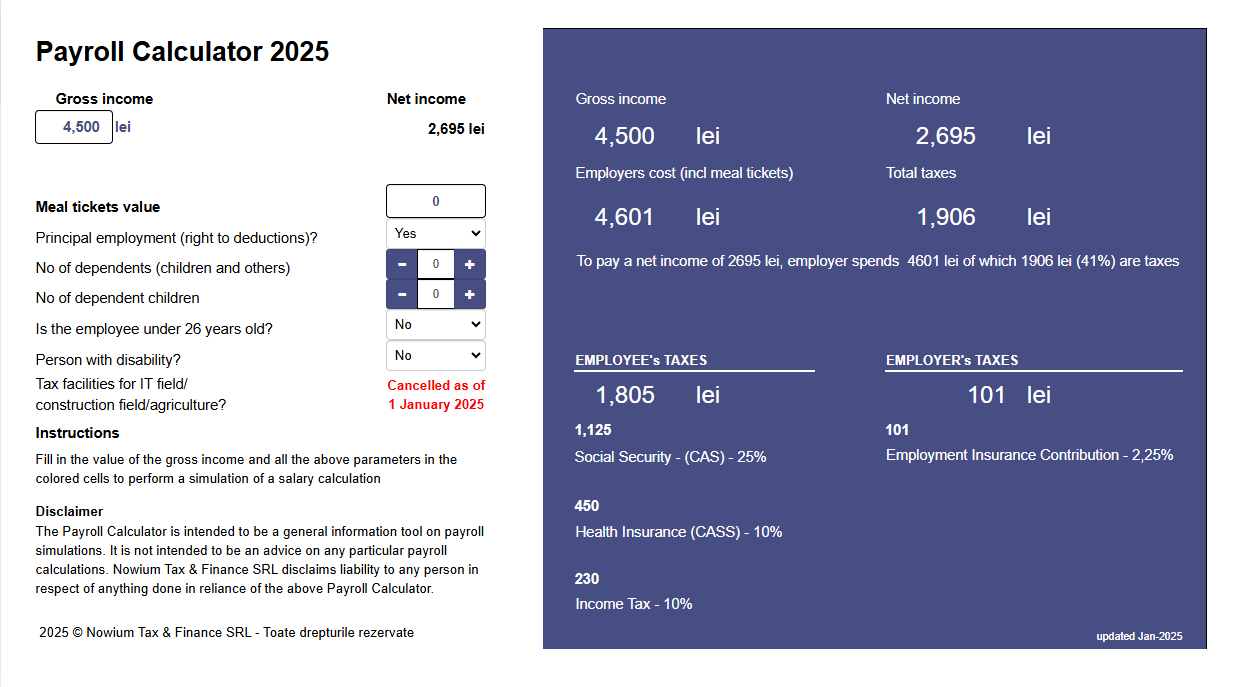
Check out our Payroll Calculator Tool on Nowium’s website
An useful free tool allowing various salary calculation scenarios, updated with the latest legislative changes. https://nowium.com/en/payroll-calculator/
Law 209/2025 to amend and complement Law 176/2018 on internships (Official Gazette 1133/2025)
Summary
The law introduces amendments to regulations on internships.
Details
The cap on the number of internship contracts allowed has been increased. Depending on the number of employees, the host organisation may simultaneously enter into internship contracts for a number of interns that cannot exceed 10% (previously 5%) of the total number of employees.
New regulations introduced:
- During the internship contract, the intern is entitled to a number of paid days off, directly proportional to the duration of the internship programme.
- If the intern does not request the rest days during the contractual period, they will not be compensated by the host organisation at the end of the internship programme.
Other fiscal news
Decision 1169/2025 on quota of newly-admitted foreign workers to the labour market in 2026 (Official Gazette 1221/2025)
For the year 2026, a quota of 90,000 newly-admitted foreign workers to the labour market in Romania is established.
Order 1607/2204/2025 to amend and complement the Order of the Minister of Labor, Family and Social Protection and of the President of the National Institute of Statistics 1832/856/2011 to approve Classification of positions in Romania – occupational level (six characters) (Official Gazette 1220/2025)
The Order updates the Classification of positions in Romania – occupational level (six characters).
Closing exchange rates for 2025
The 2025 closing NBR exchange rates to use for valuation of monetary items (cash on hand, receivables, payables) denominated in foreign currency, as well as receivables and payables denominated in RON but pegged to a foreign currency for collection/disbursement are:
1 EUR = 5,0985 RON; 1 USD = 4,3417 RON; 1 CHF = 5,4743 RON; 1 GBP = 5,8335 RON
The Resources section of our website has an Excel file through which exchange rates are automatically taken from the NBR website and are allocated on each date of validity, according to accounting rules. Thus, the exchange rate communicated by NBR on day N will be displayed on the validity dates N+1…N+2….until the next foreign exchange session.
The closing exchange rate for the month is the exchange rate communicated in the final foreign exchange session of the respective month.
The NBR Exchange Rates Retrieval Tool for 2026 is ready on our website. Click the below button to download the Excel file:

Social Indicators 2026
2026 Contributions - for dependent activities | Employer and beneficiary (for activities considered dependent) | Employee and dependent worker |
Social security contribution (pension) | - Nothing due for normal working conditions | 25% |
Contribution to health insurance fund (calculated on gross income) | Not due | 10% |
Income Tax | 10% | |
Work insurance contribution | 2,25% | |
Disability Fund (for employers with more than 50 employees) | 4 x minimum wage for every 100 employees | |
The amount of a taxable meal ticket in the sense of income tax | max. RON 45 | |
Minimum wage (gross) | -> RON 4.050 -> RON 4.582 for employees from construction sector -> RON 4.050 for agriculture and food industry sectors | |
Per Diem (in the country) | 23 lei 57.5 lei | |
The tax facilities granted to employees working in the IT sector, construction, agriculture and the food industry have been eliminated starting with the income related to January 2025. | ||