Newsletter no. 4 – April 2025

Access the magazine version of this Newsletter in pdf format: English or Romanian
Summary
- Procedure to grant 3% subsidy on annual corporate income tax and tax on micro-enterprise income (Order 540/2025)
- News on construction tax (“pillar tax”) (GEO 21/2025)
- Suspension of certain sanctions in the field of RO e-Transport (GEO 29/2025)
- Clarifications on obligation to submit SAF-T reports (Order 407/2025)
- Amendments to forms 015 and 700 (Order 468/2025)
- Procedure to register representatives of foreign legal entities that owe additional tax for legal entities carrying out activities in oil and natural gas sectors (ICAS) (Order 472/2025)
- Form 217 – “Statement related to tax on income obtained from the transfer of dismemberments of property rights under a suspensive condition” (Order 396/2025)
- Other legislative news
- April 2025 closing exchange rates
- Social indicators
How much time does your company’s payroll really take?
Find out if your current payroll system gives you the control and peace of mind you need in 3 minutes.
As an entrepreneur or executive, you know that payroll may quickly become a burden that takes valuable time. But how efficient is your current system really?
Self-assess your system and find out:
- What is your actual level of exposure to an ITM (Territorial Work Inspectorate) audit?
- How many hours may you save monthly by optimizing payroll?
- How does your system compare to market best practices?
https://start.infrared.global/nowium
Order 540/2025 to approve Procedure to grant 3% subsidy on annual corporate income tax and tax on micro-enterprise income for fiscal year 2024/modified fiscal year starting in 2024 (Official Gazette 331/2025)
Summary
The Order approves Procedure to grant 3% subsidy on annual corporate income tax and tax on micro-enterprise income for fiscal year 2024/modified fiscal year starting in 2024. The necessary forms are also approved.
Details
Who may benefit from the subsidy?
All taxpayers that:
- are corporate income taxpayers, regardless of declaration and payment system;
- are microenterprise income taxpayers.
It also applies to companies with a modified fiscal year starting in 2024.
What represents the subsidy?
It is a 3% discount on:
- Annual corporate income tax (subsequent to deducting amounts redirected for sponsorships, scholarships, etc.);
- Tax on microenterprise income, calculated as a total over the 4 quarters;
- Minimum tax on turnover (if applicable for 2024);
- Both types of tax, if during 2024 the company switched from tax on microenterprise income to tax on corporate income.
When and how it is granted?
The subsidy is calculated and granted ex officio by ANAF, subsequent to legal deadline to submit tax returns:
- Corporate income taxpayers – deadline to submit form 101;
- Microenterprise income taxpayer – deadline to submit form 100 for 4th quarter of 2024.
Conditions to benefit from the subsidy
- All tax returns should be submitted on time – situations where the obligations have been established by ANAF decision are also accepted;
- The tax related to 2024 should be paid entirely and on time;
- No outstanding fiscal obligations upon submission of the respective tax return.
How does the process work?
- ANAF automatically identifies eligible taxpayers;
- Separate lists are generated for:
- corporate income tax;
- tax on microenterprise income;
- The following are prepared:
- Supporting report;
- Decision to grant the subsidy (3%);
- Additional payment slip (i.e. subsidy amount);
- Decision is approved and communicated to taxpayer;
The subsidy is NOT refunded in cash, but:
- Will automatically settle future fiscal obligations;
- It may only be refunded if it has not been settled and the legal limitation period will soon expire.
What happens if an adjusted tax return is submitted?
If the fiscal obligation decreases ⇒ the subsidy is recalculated, and an amended decision is issued.
If the fiscal obligation increases or there is no longer any obligation ⇒ the subsidy is cancelled by a separate decision.
Emergency Ordinance 21/2025 to amend and complement Title X of Law 227/2015 on the Fiscal Code, as well as to amend and complement certain normative acts (Official Gazette 300/2025)
Summary
The Ordinance brought, among other things, amendments and clarifications related to tax on construction (“pillar tax”), which was reintroduced starting the 1st of January 2025.
Unfortunately, not all ambiguities have been clarified. Several issues related to application of tax on construction still remain open, specifically those referring to improvements made to leased spaces.
Details
Information presented in the draft Emergency Ordinance was presented in the March 2025 edition of the Nowium Newsletter. We return with a brief presentation regarding the changes brought to tax on construction.
Who owes construction tax?
1. Romanian legal entities, except public institutions, national research and development institutes, associations, foundations and other NGOs, according to laws of organization and operation;
2. Foreign legal entities carrying out activity through a permanent establishment in Romania;
3. Legal entities with registered headquarters in Romania established according to European legislation.
For financial leasing operations the taxpayer is the user, and for operational leasing operations, the taxpayer is the lessor.
Tax base and rates
The annual tax on construction is calculated as follows:
a) 5% on net value of constructions, other than those provided for by letter b), for which no tax on building is due, existing in the taxpayers’ patrimony on the 31st of December of the previous year/on the last day of the modified fiscal year prior to the year for which the tax on construction is due;
b) 25% on value of constructions from contracts/agreements or other legal acts establishing rights of administration/concession/free use/lease, in the case of those belonging to the public/private domain of the state or administrative-territorial units, existing on the 31st of December of the previous year/on the last day of the modified fiscal year prior to the year for which the tax on construction is due, but for which no tax on building is due. In this case, the tax is due by taxpayers having the constructions under administration/concession/free use/lease.
The constructions provided above are those located on the territory of Romania, representing the territory delimited by the state border of Romania, according to GEO 105/2001.
Construction located within the territorial sea of Romania as defined by Law 17/1990 regarding the legal regime of internal waters, territorial sea, contiguous zone and exclusive economic zone of Romania, republished, are not subject to tax on construction.
The net value of the constructions represents the value shown in the debit balance of accounts corresponding to constructions, from which the cumulative accounting value of their depreciation is subtracted.
Investments made to constructions that are used under management, concession, use or lease contracts, are not considered constructions in relation to this tax, if, by the 31st of December of the previous year, respectively the last day of the modified fiscal year, those investments are not classified in group 1 (Constructions) of the Catalogue on classification and regular operating durations of fixed assets.
Constructions that are exempt from local building tax are also exempt from the construction tax.
Declaration and payment deadlines
The tax on construction was introduced in the fiscal vector. Order 252/2025 published on the 3rd of March 2025 updated form 700 through which the fiscal vector is amended. Starting the 3rd of March 2025, the 15-day term provided by art. 88 of the Fiscal Procedure Code to update the fiscal vector became enforceable, resulting in the deadline of the 18th of March 2025.
Registration in the fiscal vector is carried out from the 1st of January 2025.
Fiscal year equal to calendar year
For taxpayers whose fiscal year is the same as the calendar year, the calculation and declaration of tax on construction is carried out by the 25th of May of the year for which the tax is due. The declaration is made using form 100.
Payment is made in two equal instalments by the 30th of June and the 31st of October.
Tax on construction is not paid into the Sole Account.
For declaration and advance payment of annual tax on construction by the 25th of May of the year for which the tax is due – a 10% bonus on the amount to be paid is granted.
Fiscal year different from calendar year
Calculation and declaration of tax on construction is carried out by the 25th of the fifth month of the modified fiscal year for which the tax is due.
Payment of the tax on construction is made in two equal instalments.
- by the last day of the sixth month of the modified fiscal year
- by the last day of the tenth month of the modified fiscal year
For declaration and advance payment of annual tax on construction by the 25th of the fifth month of the modified fiscal year for which the tax is due – a bonus of 10% on the amount to be paid is granted.
Newly established taxpayers
Newly established taxpayers owe tax on construction starting with the year of set-up, and the tax on construction is determined by taking into account constructions in the patrimony and/or from administration/concession/free use/lease contracts, existing on the 30th day from the registration date of the taxpayer, in the event where this date does not exceed the last day of the set-up year. In this case, the tax on construction is recalculated for the period between taxpayer’s registration date and the last day of the calendar year/modified year, when the taxpayer was set-up, by dividing the annual tax on construction by 365 calendar days and multiplying by the number of days from set-up to the entity’s year-end date.
Newly established taxpayers are required to declare and pay the tax on constructions by the 25th of January of the year following the one when they were set up, or by the 25th of the first month of the modified fiscal year following the one when they were set up.
Taxpayers that cease to exist
- recalculate tax on construction for the period of the calendar year/modified year for which the taxpayer existed, thus, the annual tax on construction is divided by 365 calendar days and multiplied by the number of days for the period of the calendar year/modified year for which the taxpayer existed.
- have the obligation to declare and pay the tax by the end of the period when the taxpayers existed.
- if the annual tax on construction was paid in advance, the tax and 10% bonus tax reduction are recalculated, and an adjusted form is submitted.
Other information
Regarding the value of constructions in contracts/agreements regulating administration/ concession/free use/lease rights in the case of constructions belonging to the public or private domain of state or administrative-territorial units:
- For contracts or agreements regulating administration/concession/free use/lease rights concluded after GEO 21/2025 entered into force it is mandatory to include the value of constructions.
- If these legal acts do not specify the value of constructions, their owners are responsible for determining this value and communicating it to taxpayers having those constructions under administration/concession/free use/lease. This communication should be made by the 15th of May 2025, respectively by the 15th of the fifth month of the modified fiscal year starting in 2025.
If, during the current year, there are operations increasing or decreasing the value of constructions, the tax is not recalculated. These changes are taken into account to determine the tax on construction due for the following year.
The tax on construction expense is deductible when calculating corporate income tax.
The Ordinance repealed the article from the previous regulation by which the Ministry of Finance had to issue Application Norms within 90 days.
Tax Group
🔥 New! The Tax Group platform has been completely redesigned! With a modern look, new features, and an improved user experience, accessing essential information is now easier than ever.
🔹 Stay up to date with the latest tax news! 🔹
Tax legislation is constantly changing, and the right decisions depend on accurate, up-to-date information. Tax Group gives you monthly access to key legislative updates and expert analysis.
📌 Join now and explore the new platform!
🔗 Visit www.taxgroup.ro to watch a teaser of a Tax Group event and discover the benefits of a professional subscription!

Emergency Ordinance 29/2025 to suspend application of certain provisions of GEO 41/2022 to set up national RO e-Transport system to monitor road transport for goods and to repeal art. XXVIII of GEO 130/2021 on certain fiscal and budgetary measures, the extension of certain deadlines, as well as to amend and complement certain normative acts (Official Gazette 365/2025)
Summary
The Ordinance extends the suspension of sanctions applied for failure to transmit GPS coordinates in the RO e-Transport system.
Details
The suspension of sanctions comes due to issues “reported by business environment representatives regarding the time needed to fully implement and test internal systems in accordance with RO e-Transport requirements, as well as the need to adapt taxpayers’ IT systems and work methodologies to the compliance requirements regarding the transfer of current transport vehicle positioning data, which are subject to declaration throughout the transport route of goods subject to monitoring through the RO e-Transport system.”
We emphasise that through GEO 129/2024, sanctions for non-compliance regarding transfer of vehicle positioning data to the RO e-Transport system were suspended through the 31st of March 2025. The ordinance extends the suspension through the 31st of December 2025.
The sanctions subject to suspension are:
- The driver of the transport vehicle is obliged to turn on the positioning device before starting the transport on national territory, and then to turn off the positioning device only after delivering the goods to the declared delivery location on national territory or after leaving the national territory. In this situation, fines for non-compliance are between RON 5,000 and RON 10,000.
- The road transport operator is obliged to ensure the transfer of current positioning data of the transport vehicle, which are the subject to declaration, throughout the transport route of goods that are subject to monitoring through the RO e-Transport System. The road transport operator is obliged to equip transport vehicles with telecommunications terminal devices that use satellite positioning and data transmission technologies. These provisions do not apply if the positioning data of the transport vehicle are transferred by its devices. In this situation, the fines are from RON 10,000 to RON 50,000 in the case of individuals or a fine from RON 20,000 to RON 100,000 in the case of legal entities.
Order 407/2025 to amend Annex No. 5 to ANAF Presidential Order 1783/2021 on the nature of information that the taxpayer should declare through a standard tax audit file, reporting template, the procedure and conditions for transmission, as well as transmission deadlines and date(s) from which the categories of taxpayers are required to submit the standard audit tax file (Official Gazette 310/2025)
Summary
The Order clarifies the exemption to submit for 406 (SAF-T file) for new entities. Previously, they were not specifically mentioned on the list of exceptions.
Details
Thus, the following are exempt from submitting SAF-T report:
- all individual taxpayers who obtain income from liberal professions, as well as professional partnerships/offices/other forms of organization within which they carry out their liberal profession and whose activity is organized and regulated by special laws.
Previously, the list of exceptions specifically mentioned only the following categories:
- professional law firms with limited liability and individual law firms;
- professional partnerships of notaries and individual notary offices;
- individual medical offices;
- professional partnerships of insolvency practitioners.
- NGOs, House Tenants’ & Flat Owners’ Association and churches that use single-entry bookkeeping. If these associations/persons/entities opt for double-entry bookkeeping, these entities are required to submit SAF-T reports.
- legal entities whose activity is temporarily suspended by registering this state at the Trade Register, for the period when the activity is temporarily suspended. Also, other entities that have requested suspension of activity from the authorities that authorized them, are not obliged to submit SAF-T reports for the period when the activity is temporarily suspended.
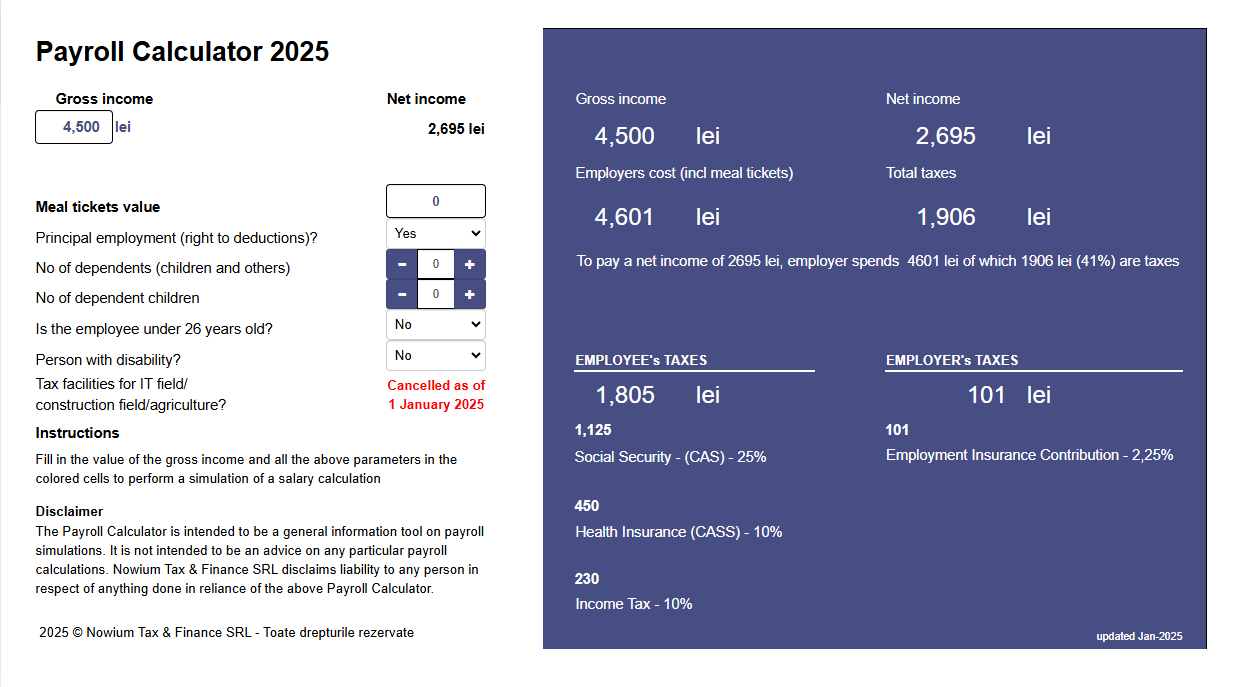
Check out our Payroll Calculator Tool on Nowium’s website
An useful free tool allowing various salary calculation scenarios, updated with the latest legislative changes. https://nowium.com/en/payroll-calculator/
Order 468/2025 to complement ANAF Presidential Order 3775/2015 to approve certain special competences of the central fiscal authority, as well as to amend and complement ANAF Presidential Order 1699/2021 to approve tax registration forms of taxpayers and types of fiscal obligations that form the fiscal vector (Official Gazette 302/2025)
Summary
The Order brings a series of changes to taxpayers’ tax registration forms, including types of fiscal obligations that form the fiscal vector, as well as the approval of special competences for central fiscal authority.
Details
We present below the main changes introduced by this order.
1. New categories of taxpayers that will be administered by Fiscal Administration for Non-resident Taxpayers within Directorate-General of Public Finances of Bucharest
- non-resident legal entities that are not required to register a permanent establishment on the territory of Romania and that owe taxes according to legislation in the field of gambling;
- foreign legal entities established in the European Union which, according to law, are directly registered and which owe specific tax on turnover as a result of carrying out activities in the oil and natural gas sectors.
As an exception, for a taxable entity individual which has its place of its economic activity outside Romania and requests VAT registration in Romania through a large or medium-sized taxpayer fiscal representative, the competence for fiscal registration/registration under the scope of VAT, as well as for subsequent updates related to fiscal registration/registration under the scope of VAT lies with the fiscal authority in whose territorial jurisdiction the headquarters of the fiscal representative is located. Subsequent to fiscal registration, competence for fiscal administration of the non-resident taxable entity individual lies with the fiscal authority established according to provisions mentioned above.
2. Updated forms 015 and 700
a) Form 015
The two categories of non-resident legal entities mentioned at point 1 above are added, as well as new lines for taxes owed by these categories of taxpayers.
b) Form 700
For the section, Other taxpayer data, a new line was introduced – Specific tax on turnover owed by legal entities carrying out activities in oil and natural gas sectors. The row is destined for taxpayers that do not have a permanent establishment in Romania and owe this tax.
The Order designates the competent fiscal authority to analyse the Application to establish fiscal residency of foreign companies that establish their location of effective management in Romania. In such situations, the competent fiscal authority that receives and analyses the Application will be the one in whose territorial scope the non-resident taxpayer will exercise administrative management and effective management of the business.
Order 472/2025 to approve Procedure and conditions to register representatives of foreign legal entities provided by art. 46^2 para. (1^1) of Law 227/2015 on the Fiscal Code that are required to calculate, declare and pay specific tax on turnover provided by art. 46^2 of Law 227/2015, as well as template and the content of form 178 – Decision to approve/reject application to appoint a representative according to art. 46^2 para. (13) of the Fiscal Code (Official Gazette 303/2025)
Summary
The Order approves procedure and form to register representatives of foreign legal entities that owe additional tax for legal entities carrying out activities in the oil and gas sectors (ICAS).
Details
The non-resident taxpayer that owes ICAS and is not fiscally registered in Romania should request fiscal registration by submitting form 015 – Declaration of fiscal registration/Declaration of mentions/Declaration of deregistration for non-resident taxpayers which do not have a permanent headquarters in Romania.
The form is submitted to the competent fiscal authority given the registration of the designated representative.
The designated representative may be any Romanian legal entity, with fiscal domicile in Romania, which has fulfilled all declarative obligations, according to fiscal vector, and which is not in fiscal inactivity. Only one representative is allowed for all obligations incumbent on it.
The application to appoint a representative should be submitted along with the following documents:
- the power of attorney, which specifically states the capacity of the representative to fulfil the obligations incumbent on the non-resident taxpayer;
- the written acceptance of the person proposed as representative, by which he/she undertakes to fulfil his/her obligations and to be jointly and severally liable with the non-resident taxpayer for the declaration and payment of the specific tax on turnover.
ANAF communicates the decision taken within 3 days from the receipt date of the application to appoint the representative. The decision may be appealed.
The special record of appointed representatives contains the following information:
a) identification data, specifically, name and fiscal identification code of the person appointed as representative and accepted by the fiscal authority;
b) identification data, specifically, name and fiscal identification code of the non-resident taxpayer for whom the representative was accepted;
c) decision number and date by which the fiscal authority approved the application to appoint the representative;
d) the date on which the representative’s mandate begins and the date on which it ends. The date on which the representative’s mandate begins is the communication date of the decision to accept the representative or a later date established by the power of attorney submitted to the fiscal authority.
If the representative’s mandate ends, the non-resident taxpayer should notify the competent fiscal authority in writing that the representative’s mandate has ended.
If the representative’s mandate ends, but the non-resident taxpayer continues economic activity in Romania for which it owes specific tax on turnover, it is obliged to either extend the representative’s mandate, or to mandate another representative, or to register directly, if it is a foreign legal entity established in the European Union.
If the fiscal administration competence of the non-resident taxpayer changes, according to law, the previous competent fiscal authority transmits to the new competent fiscal authority as well as the information regarding the representative accepted by the fiscal authority, registered in the special record of appointed representatives.
The order also regulates form 178 to approve or reject applications to appoint fiscal representatives, as well as a procedure to register representatives of foreign legal entities.
Order 396/2025 to approve template, content, method of submission and management of form 217 – “Statement related to tax on income obtained from the transfer of dismemberments of property rights under a suspensive condition” (Official Gazette 287/2025)
Summary
The Order approves template and content of form 217 – Statement related to tax on income obtained from the transfer of dismemberments of property rights under a suspensive condition.
Details
The form is completed and submitted by individuals who receive income from transfer of dismemberments of property rights under a suspensive condition, from income payers, other than legal entities or other entities that are required to keep accounting records:
- for income determined and collected after authentication of the notarial deed through which the dismemberments are transferred;
- for income determined and collected subsequent to transfer of dismemberments by final court decision or other legal act provided by law;
- for the income received from the transfer of dismemberments of the ownership right under a suspensive condition, as a result of acquiring, through inter vivos acts or mortis causa, the ownership right over a real estate property that was subject to a transfer of the dismemberments of the ownership right under a suspensive condition.
For the situations mentioned above, the form is also submitted by individuals who, during the period of 5-31 December 2024, received income from transfer of dismemberments under a suspensive condition, paid by legal entities or other entities that are obliged to keep accounting records.
The form is not submitted by individuals who receive, starting the 1st of January 2025, income from transfer of dismemberments under the suspensive condition, paid by legal entities or other entities that are required to keep accounting records, for which the tax is withheld at source by the income payers.
Submission deadline
The form is submitted by the 25th of the month following the quarter when the income was received. For income received during the fourth quarter of 2024 from transfer of dismemberments over real estate properties from personal assets, taxpayers are required to declare the tax due by the 25th of April 2025.
Submission
The form is submitted in written form, directly to the registry office of the competent fiscal authority or is communicated by mail, with confirmation of receipt. The form may also be submitted by electronic means of remote transmission, according to law.
The competent fiscal authority is:
- the central fiscal authority within whose territorial jurisdiction the taxpayer has the address of his domicile, according to law, or the address where he or she actually lives, if this is different from the domicile, for individuals who have their fiscal domicile in Romania;
- the competent central fiscal authority responsible for, according to law, the administration of individual taxpayers without fiscal residence in Romania.
Order 582/2025 to amend and complement Order of the Minister of Finance 699/2024 to transmit quarterly and annual financial statements, as well as certain centralized monthly financial reports prepared by public institutions starting 2024 and to amend and complement orders of the Minister of Public Finance in the field of public institutions accounting (Official Gazette 320/2025)
Closing exchange rates for April 2025
The April 2025 closing NBR exchange rates to use for valuation of monetary items (cash on hand, receivables, payables) denominated in foreign currency, as well as receivables and payables denominated in RON but pegged to a foreign currency for collection/disbursement are:
1 EUR = 4.9775 RON; 1 USD = 4.3787 RON; 1 CHF = 5.3042 RON; 1 GBP = 5.8518 RON
The Resources section of our website has an Excel file through which the exchange rates are automatically taken from the NBR website and are allocated on each date of validity, according to accounting rules. Thus, the exchange rate communicated by NBR on day N will be displayed on the validity dates N+1…N+2….until the next foreign exchange session.
The closing exchange rate for the month is the exchange rate communicated in the final foreign exchange session of the respective month.
Social Indicators 2025
2025 Contributions - for dependent activities | Employer and beneficiary (for activities considered dependent) | Employee and dependent worker |
Social security contribution (pension) | - Nothing due for normal working conditions | 25% |
Contribution to health insurance fund (calculated on gross income) | Not due | 10% |
Income Tax | 10% | |
Work insurance contribution | 2,25% | |
Disability Fund (for employers with more than 50 employees) | 4 x minimum wage for every 100 employees | |
The amount of a taxable meal ticket in the sense of income tax | max. RON 40.04 | |
Minimum wage (gross) | -> RON 4.050 (starting with January 2025 related income) -> RON 4.582 for employees from construction sector -> RON 4.050 for agriculture and food industry sectors (starting with January 2025 related income) | |
Per Diem (in the country) | 23 lei 57.5 lei | |
The tax facilities granted to employees working in the IT sector, construction, agriculture and the food industry have been eliminated starting with the income related to January 2025. | ||