Newsletter no. 6 – June 2025

Access the magazine version of this Newsletter in pdf format: English or Romanian
Summary
- Regulation of the accounting reporting method by entities that opt for a financial year different from the calendar year (Order 899/2025)
- Amendments to Classification of Occupations in Romania (Order 325/1109/2025)
- Update of DAC6 form (Order 755/2025)
- INFO – RO e-VAT
- June 2025 closing exchange rates
- Social indicators
Assess your team’s readiness for fiscal challenges
Answer 10 questions in less than 3 minutes and find out how well your accounting team is coping with legislative changes!
✔️ Is your team up to date with all fiscal news?
✔️ What hidden risks may arise from the lack of continuous updating?
✔️ How can you transform uncertainty into efficiency and fiscal security?
Complete the quiz and get a clear picture of your team’s level of training – an essential resource in any company!
👉 In an ever-changing fiscal environment, constant training is no longer optional, but a competitive advantage!
https://start.infrared.global/taxgroup
Order 899/2025 on regulation of accounting reporting method by entities that opt for a financial year different from the calendar year (Official Gazette 550/2025)
Summary
The Order establishes the reporting method for entities that opt for a financial year different from the calendar year and includes provisions applicable to both economic operators and NGOs that choose a different financial year.
Details
The Order includes regulations concerning the reports and financial statements prepared by entities opting for a financial year different from the calendar year, regarding:
- annual financial statements;
- the situation in which the chosen date for preparation of annual financial statements is changed so that the reporting financial year once again becomes the calendar year or a financial year already different from the calendar year is modified;
- financial statements prepared on the occasion of mergers, divisions, and transformations, as well as in the case of liquidation.
The main provisions are presented below.
Annual accounting reports
Entities that opt for a financial year different from the calendar year prepare annual accounting reports as of the 31st of December, separately from annual financial statements prepared on their selected date.
These reports should be submitted to ANAF by the 31st of May of the financial year following the reporting year.
Annual financial statements
When preparing the balance sheet/statement of financial position, in addition to amounts corresponding to the two reporting dates, the balances on the 1st of January of the financial year preceding the one to which the annual financial statements refer will also be included. These provisions do not apply to entities that opted for a financial year different from the calendar year starting from their date of establishment.
When preparing the profit and loss account/statement of financial performance/income statement, amounts corresponding to the period prior to the reporting period will include turnover recorded from the 1st of January of the financial year preceding the year to which the annual financial statements refer, up to the beginning of the reporting period.
Example: For an entity applying OMPF 1802/2014 and choosing the 31st of March 2025 as the reporting date for its annual financial statements:
- the balance sheet, as part of the annual financial statements prepared on the 31st of March 2025, includes 3 columns with balances for the following dates: the 1st of January 2024; the 1st of April 2024; and the 31st of March 2025;
- the profit and loss account, as part of the annual financial statements prepared on the 31st of March 2025, includes two columns with turnover for the periods of 1st of January 2024 – the 31st of March 2024 and the 1st of April 2024 – the 31st of March 2025.
Entities that opt for a financial year different from the calendar year and whose annual financial statements also include the statement of changes in equity should present the equity changes relative to the beginning and end of the reporting period.
Example: For an entity applying OMPF 1802/2014 and choosing the 31st of March 2025 as the reporting date for the annual financial statements, the equity changes are reported between the 1st of April 2024 and the 31st of March 2025.
Entities that opt for a financial year different from the calendar year and whose annual financial statements also include the cash flow statement should present, for the financial year preceding the reporting year, cash flow is recorded from the 1st of January of the preceding financial year to the start of the reporting period.
Example: For an entity applying OMPF 1802/2014 and choosing the 31st of March 2025 as the reporting date for the annual financial statements, the reported cash flows correspond to the periods of 1st of January 2024 – the 31st of March 2024 and the 1st of April 2024 – the 31st of March 2025.
The reporting method described above applies whenever an entity chooses a financial year different from the calendar year and is described in the disclosure notes accompanying annual financial statements.
Return to calendar year
If the entity changes the chosen date for preparing annual financial statements so that the reporting financial year becomes the calendar year again, the balance sheet figures reported starting with the next completed financial year refer to the 1st of January and the 31st of December, and the income and expense account turnover corresponds to the current financial year and the financial year preceding the reporting year.
Thus, the reporting method applies whenever the entity returns to the calendar year and is presented in the disclosure notes accompanying annual financial statements.
Example: For an entity applying OMPF 1802/2014, which had chosen the 31st of August as the reporting date for its annual financial statements and returns to the calendar year starting the 1st of January 2025, for comparability, the information is reported as follows:
- the balance sheet, as part of annual financial statements prepared on the 31st of December 2025, includes balances for the 1st of January 2025 and the 31st of December 2025;
- the profit and loss account, as part of the annual financial statements prepared on the 31st of December 2025, includes two columns with turnover for the periods of the 1st of January 2024 – the 31st of December 2024 and the 1st of January 2025 – the 31st of December 2025.
Annual financial statements for mergers, divisions, transformations, and liquidation
These types of financial statements, for entities that have chosen a different duration for their financial year, are special purpose financial statements for which comparative information is not required.
Thus, the balance sheet/statement of financial position includes balances corresponding to the date of the financial statements prepared on the occasion of the merger, division, or transformation, as well as in the event of the entity’s liquidation, according to law.
The profit and loss account/statement of financial performance/income statement includes turnover corresponding to the period from the beginning of the financial year following the year to which the last general-purpose financial statements refer – to the date of the financial statements prepared on the occasion of the merger, division, or transformation, as well as in the event of the entity’s liquidation, according to law.
Example: An entity applying OMPF 1802/2014, which prepared annual financial statements on the 31st of March 2024 and established the 31st of August 2024 as the date for reorganization, should observe the following rules:
- the balance sheet as part of annual financial statements prepared on the 31st of August 2024 includes balances as of the 31st of August 2024;
- the profit and loss account as part of annual financial statements prepared on the 31st of August 2024 includes turnover for the period of the 1st of April 2024 – the 31st of August 2024.
Entities falling under OMPF 1802/2014 should also apply provisions of OMPF 897/2015 for the approval of Methodological Norms on accounting treatment for main operations of merger, division, dissolution, and liquidation of companies, as well as the withdrawal or exclusion of associates from companies.
How much time does your company’s payroll really take?
Find out if your current payroll system gives you the control and peace of mind you need in 3 minutes.
As an entrepreneur or executive, you know that payroll may quickly become a burden that takes valuable time. But how efficient is your current system really?
Self-assess your system and find out:
- What is your actual level of exposure to an ITM (Territorial Work Inspectorate) audit?
- How many hours may you save monthly by optimizing payroll?
- How does your system compare to market best practices?
https://start.infrared.global/nowium
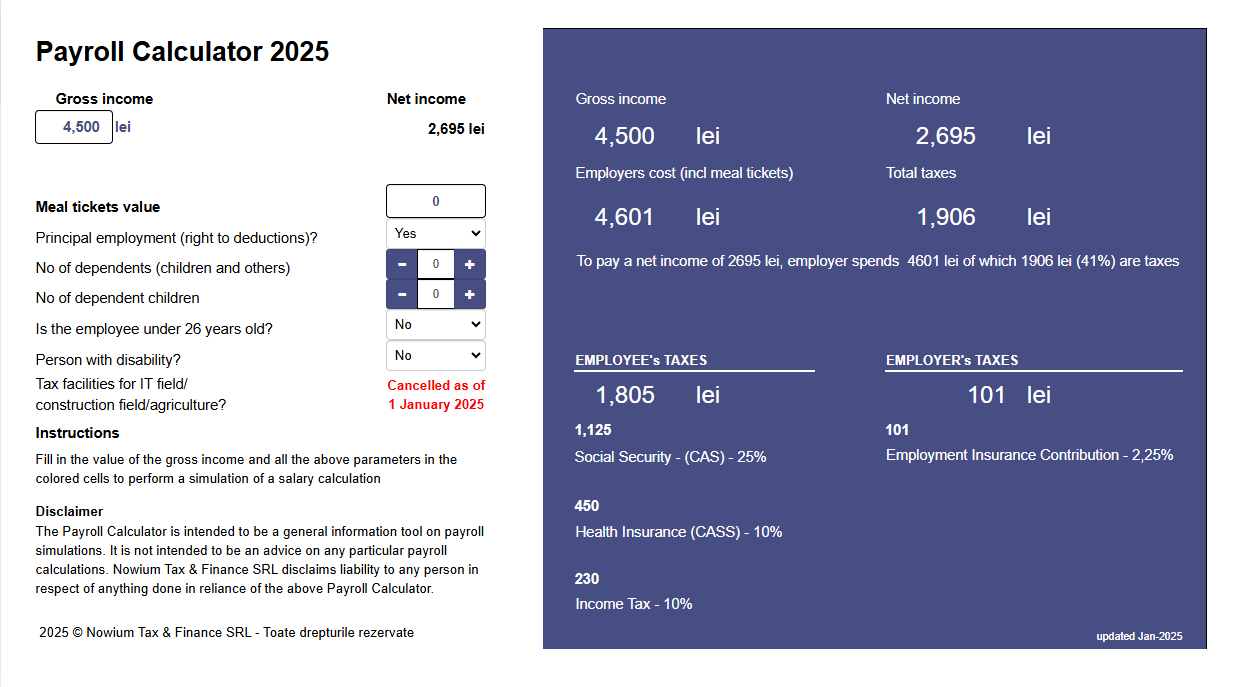
Check out our Payroll Calculator Tool on Nowium’s website
An useful free tool allowing various salary calculation scenarios, updated with the latest legislative changes. https://nowium.com/en/payroll-calculator/
Order 325/1109/2025 to amend and complement the Classification of Occupations in Romania – occupation level (six characters), approved by Order of the Minister of Labour, Family and Social Protection and the President of the National Institute of Statistics no. 1832/856/2011 (Official Gazette 520/2025)
This Order updates/complements the Classification of Occupations in Romania – occupation level (six characters), approved by Order of the Minister of Labour, Family and Social Protection and the President of the National Institute of Statistics no. 1832/856/2011.
Thus, the following new positions are defined:
- 2D/3D digital animator for video games – 251309
- 2D digital artist for video games – 251310
- 3D digital artist for video games – 251311
- Bioinformatics researcher – 213153
- Video game community coordinator – 351210
- Video game testing team coordinator – 351110
- Digital game level designer – 251308
- Oenologist – 214539
- Pilates instructor – 342311
- Instructor-trainer of Romanian language, culture, and civilization – 235927
- Dog caretaker – 516405
- Environmental protection biotechnology operator – 818909
- Digital game creation operator – 351204
- Digital game testing operator – 351109
- 2D/3D digital animator technician for video games – 351207
- 2D digital art technician for video games – 351208
- 3D digital art technician for video games – 351209
- Digital game level design technician – 351206
- Digital game designer technician – 351205
The occupation, “information security manager (Chief Information Security Officer – CISO),” is moved from major group 1211 “Managers in financial services” to major group 1330 “Managers in information and communication technology services,” with the code 133048.
How solid is your business model when it comes to transfer pricing rules?
Find out in just 3 minutes if your business model complies with legal requirements for related-party transactions and if you are exposed to tax risks!
✔️ Are you required to prepare a transfer pricing file?
✔️ What are your chances of being selected for an audit?
✔️ How do you compare to the best market practices?
Complete the quick questionnaire and get a clear self-assessment of your compliance level.
👉 Don’t leave compliance to chance. Protect your company, avoid fines and costly adjustments!
https://start.infrared.global/preturidetransfer
Order 755/2025 to amend Annex No. 1 to ANAF Presidential Order 1029/2020 on the approval of form used by intermediaries or relevant taxpayers, as applicable, for reporting information on reportable cross-border arrangements (Official Gazette 566/2025)
The Order introduces amendments to the form used by intermediaries or relevant taxpayers, as applicable, to report information on cross-border arrangements that are subject to reporting. Specifically, it concerns the DAC6 form.
According to the new order, the description of the arrangements should now be provided in both Romanian and English, since Romanian authorities exchange information with the authorities of other EU Member States. Previously, the reports were submitted in Romanian only. It is also stated that national provisions should be complemented by the national legal provisions forming the basis of the cross-border arrangement, and these should also be reported in both languages.
INFO – RO e-VAT
Please note that the suspension period for penalties related to failure of taxpayers to submit the results of checks on differences communicated by the fiscal authority through RO e-VAT Compliance Notification expires on the 1st of July 2025.
As a reminder, if ANAF identifies significant differences between the values via the pre-filled RO e-VAT return (P300ETVA) and the values completed by the taxable entity registered under the scope of VAT in their submitted VAT return (D300), the taxable entity is notified electronically.
Significant differences refer to values that cumulatively exceed the following thresholds: a minimum 20% difference and an absolute value of at least RON 5,000, resulting from comparing the rows in the submitted VAT return with those in the pre-filled RO e-VAT return.
After identifying the significant differences, the RO e-VAT Compliance Notification is sent no later than the 5th day of the month following the legal deadline to submit the VAT return.
Sanctions
Starting the 1st of July 2025 for most taxpayers, and the 1st of August 2025 for those applying the cash accounting VAT scheme, the following fines apply for failing to submit the results of the checks on differences communicated through RO e-VAT Compliance Notification:
- RON 5,000 to 10,000 for large taxpayers;
- RON 2,500 to 5,000 for medium taxpayers;
- RON 1,000 to 2,500 for other legal entities, as well as for individuals.
The above contraventions are subject to provisions of Law 270/2017 on prevention.
More details about RO e-VAT will be discussed at the Tax Group event on the 17th of July 2025.

Closing exchange rates for June 2025
The June 2025 closing NBR exchange rates to use for valuation of monetary items (cash on hand, receivables, payables) denominated in foreign currency, as well as receivables and payables denominated in RON but pegged to a foreign currency for collection/disbursement are:
1 EUR = 5.0777 RON; 1 USD = 4.3329 RON; 1 CHF = 5.4345 RON; 1 GBP = 5.9329 RON
The Resources section of our website has an Excel file through which exchange rates are automatically taken from the NBR website and are allocated on each date of validity, according to accounting rules. Thus, the exchange rate communicated by NBR on day N will be displayed on the validity dates N+1…N+2….until the next foreign exchange session.
The closing exchange rate for the month is the exchange rate communicated in the final foreign exchange session of the respective month.
Social Indicators 2025
2025 Contributions - for dependent activities | Employer and beneficiary (for activities considered dependent) | Employee and dependent worker |
Social security contribution (pension) | - Nothing due for normal working conditions | 25% |
Contribution to health insurance fund (calculated on gross income) | Not due | 10% |
Income Tax | 10% | |
Work insurance contribution | 2,25% | |
Disability Fund (for employers with more than 50 employees) | 4 x minimum wage for every 100 employees | |
The amount of a taxable meal ticket in the sense of income tax | max. RON 40.04 | |
Minimum wage (gross) | -> RON 4.050 (starting with January 2025 related income) -> RON 4.582 for employees from construction sector -> RON 4.050 for agriculture and food industry sectors (starting with January 2025 related income) | |
Per Diem (in the country) | 23 lei 57.5 lei | |
The tax facilities granted to employees working in the IT sector, construction, agriculture and the food industry have been eliminated starting with the income related to January 2025. | ||