Newsletter no. 8 – August 2025

Access the magazine version of this Newsletter in pdf format: English or Romanian
Summary
- Change of VAT exemption threshold and other VAT-related changes (Draft)
- Amendment of Application Norms of the Fiscal Code regarding VAT (GD 602/2025)
- Update of Sole Tax Return in order to declare health insurance contributions (CASS) for co-ensured persons (Order 1929/2025)
- News on sustainability reporting requirements (Order 1421/2025)
- Accounting reporting system as of the 30th of June 2025 (Order 1194/2025)
- Update of form 112 (Order 248/1377/2066/3103/2025)
- August 2025 closing exchange rate
- Social indicators
Draft: Ordinance to amend and complement Law 227/2015 on the Fiscal Code
Summary
A measure announced earlier this spring was adopted during the Government meeting on Thursday, the 28th of August 2025. Starting the 1st of September 2025, the national VAT exemption threshold for small-size companies will increase from RON 300,000 to RON 395,000.
Details
New national VAT exemption threshold
Starting the 1st of September 2025, the national VAT exemption threshold for small-size companies will increase from RON 300,000 to RON 395,000.
This means that small companies – namely, taxable entities established in Romania with an annual turnover below RON 395,000 – will also have the option to apply the special VAT scheme in other EU Member States, provided their EU-wide turnover does not exceed EUR 100,000 and their operations in the respective Member State remain below that country’s local exemption threshold.
In practice, this regime allows such companies not to charge VAT on their supply/provision of goods/services, but it also prevents them from deducting VAT on their purchases.
With this measure, Romania is transposing into domestic law the provisions of EU Directive 2020/285, which grants small companies the option to apply the special exemption scheme in Member States other than the one where they are established.
Transition from previous to new threshold
Taxable entities exceeding in August 2025 the previous VAT exemption threshold for small companies of RON 300,000 (the threshold applicable prior to the entry into force of the Government Ordinance) are not required to register under the scope of VAT, unless they also exceed the new annual exemption threshold of RON 395,000.
If the turnover of RON 395,000 was also exceeded during August 2025, the taxable entity should apply for VAT registration no later than the 10th of September 2025, and will be subject to standard VAT regime starting from that date.
The VAT registration of such entities will be deemed valid as of the 10th of September 2025.
VAT deregistration
Taxable entities established prior to 2025, registered under the scope of VAT prior to the 1st of September 2025, as a result of exceeding the VAT exemption threshold of RON 300,000, may request the VAT deregistration in order to apply the special exemption regime, provided that they did not exceed the exemption threshold of RON 300,000 during the previous year (2024), and that by the date of submitting the deregistration request they have not exceeded the new exemption threshold of RON 395,000. The VAT deregistration may be requested starting the 1st of September 2025.
Taxable entities established in 2025, registered under the scope of VAT by 1st of September 2025, as a result of exceeding the exemption threshold of RON 300,000, may request VAT deregistration in order to apply the special exemption regime, provided that by the date of submitting the deregistration request they have not exceeded the exemption threshold of RON 395,000. The VAT deregistration may be requested starting the 1st of September 2025.
The request for VAT deregistration, in these cases, may be submitted to the competent fiscal authorities between the 1st and 10th of each month following the fiscal period applied by the taxable entity. The cancellation of VAT registration will be effective as of the date when the decision on VAT deregistration is communicated.
Updates on online events
Provisions of the European Directive on VAT rates are also being transposed into domestic law. These mainly concern changes to rules governing the place of supply for activities/events that involve virtual attendance, are streamed online, or are made available through other virtual means, in order to ensure taxation in the Member State of consumption.
Thus, services provided to a client by electronic means are taxable in the place where the client is established, has their permanent address, or usually resides.

Decision 602/2025 to amend and complement title VII Value added tax from Methodological Norms to apply Law 227/2015 on the Fiscal Code, approved by GD 1/2016 (Official Gazette 715/2025)
Summary
The Decision updates Methodological Norms to apply Title VII Value Added Tax of the Fiscal Code as a result of recent changes to VAT rates brought by Law 141/2025.
Briefly, among the amendments are:
- updated list of NC tariff codes to which the reduced 11% rate applies, in the case of food, including beverages, intended for human or animal consumption, and live animals and birds of domestic species;
- updates of references to VAT rates, as a result of their change;
- other amendments.
Details
Among the most important changes, we mention:
Update of reference rate
All references to previous VAT rates (5%, 9%, and 19%) are updated to reflect the new VAT rates. Also, references to articles and paragraphs of the Fiscal Code are updated, following the renumbering of legislative articles that are subject to reduced 11% rate. Last but not least, the paragraphs detailing the application of the reduced rate to certain operations are eliminated, as a result of those operations shifting from the reduced VAT rate to standard VAT rate.
Food
Law 141/2025 reduced the list of food products eligible for the reduced 11% VAT rate. The Methodological Norms are complemented with new provisions that define the concepts of food intended for human consumption and food intended for animal consumption, i.e., animal food, by reference to Regulation (EC) No. 178/2002:
- food intended for human consumption means any substance or product, whether processed, partially processed, or unprocessed, intended to be, or reasonably expected to be, ingested by humans;
- food intended for animal consumption means any substance or product, including additives, whether processed, partially processed, or unprocessed, intended to be used as oral food for animals;
The NC tariff codes to which the reduced 11% VAT rate applies for food products have been updated, including the elimination of the possibility to apply the reduced rate for:
- seeds
- plants and ingredients used in food preparation
- products used to complement or replace food
- cozonac (traditional sweet bread), biscuits
- bee food.
The list of goods for which (except foods with added sugar, whose total sugar content is at least 10 g/100 g of product, due to their nature) the supply by any provider is subject to the reduced 11% VAT rate is shortened. The reduced rate now applies only if the provider may prove that the goods are used for human or animal consumption. Previously, this category also included goods used for preparing food for human or animal consumption or for complementing or replacing such food.
The reduced 11% VAT rate applies throughout the entire economic chain, by all suppliers, regardless of their status (producers or traders), for delivery of goods falling under NC tariff codes specified in the norms, regardless of their destination, except for foods with added sugar whose total sugar content is at least 10 g/100 g of product, other than baby/infant formula.
Food supplements
The provisions on the reduced VAT rate applicable for supply, import, or intra-Community purchase of food supplements are repealed (they are now taxable at the standard rate of 21%).
Delivery of housing
The related provisions for applying the reduced VAT rate to the delivery of housing to individuals are eliminated, since this will no longer be subject to the reduced VAT rate (except the transition period which will end on the 1st of August 2026).
Books and education
The reduced rate applies to books and school textbooks with an ISBN or ISMN code, regardless of the format in which they are delivered.
There are no longer any restrictions on applying the reduced rate to the delivery of books, newspapers, and magazines by electronic means, which were previously considered to be services.
Order 1929/2025 to amend ANAF Presidential Order 7015/2024 to approve template, content, means to submit and administer/manage form (212) Sole Tax Return on income tax and social contributions owed by individuals (Official Gazette 713/2025)
Summary
The order updates form (212) Sole Tax Return on income tax and social contributions owed by individuals. The amendment was necessary as a result of recent legislative changes related to payment of health insurance contributions (CASS) for co-ensured persons.
Details
As a reminder, starting the 1st of August 2025, co-ensuring an individual involves the separate payment of the health insurance contribution (CASS). Thus, in order to obtain the status of a co-ensured person, it is mandatory to pay CASS separately for the co-ensured individual, according to amendments introduced by Law 141/2025. In this regard, the Sole Tax Return (form 212) should be submitted to ANAF, and the CASS payment is made in two installments: 25% upon submission of form 212, and the remaining 75% by the 25th of May of the following year. In 2025, the CASS contribution amounts to RON 2,430 RON (i.e., 10% applied to calculation base determined as 6 gross minimum wages of RON 4,050 each).
Returning to the new Sole Tax Return, Chapter II Information on health insurance contribution (CASS) owed by individuals who opt to pay contribution for 2025 has been amended. This chapter now includes the following sections:
- Section 1: Information on CASS owed by individuals who opt to pay CASS according to art. 180 of the Fiscal Code, which is to be filled in by individuals who, during the current year, choose to pay health insurance contribution according to provisions of art. 180 of the Fiscal Code;
- Section 2: Information on CASS owed by individuals for dependent persons according to art. 182^1 of the Fiscal Code, which is to be filled in by individuals obtaining income as defined in art. 155 para. (1) of the Fiscal Code and who opt to pay health insurance contribution for dependent persons referred to in art. 224 para. (1^2) of Law 95/2006 on healthcare reform;
- Section 3: Summary of CASS obligations owed by individuals who opt to pay the contribution for 2025, which is to be filled in to reflect the total amount of fiscal obligations due for 2025.
The Order also updated instructions to fill the Sole Tax Return.
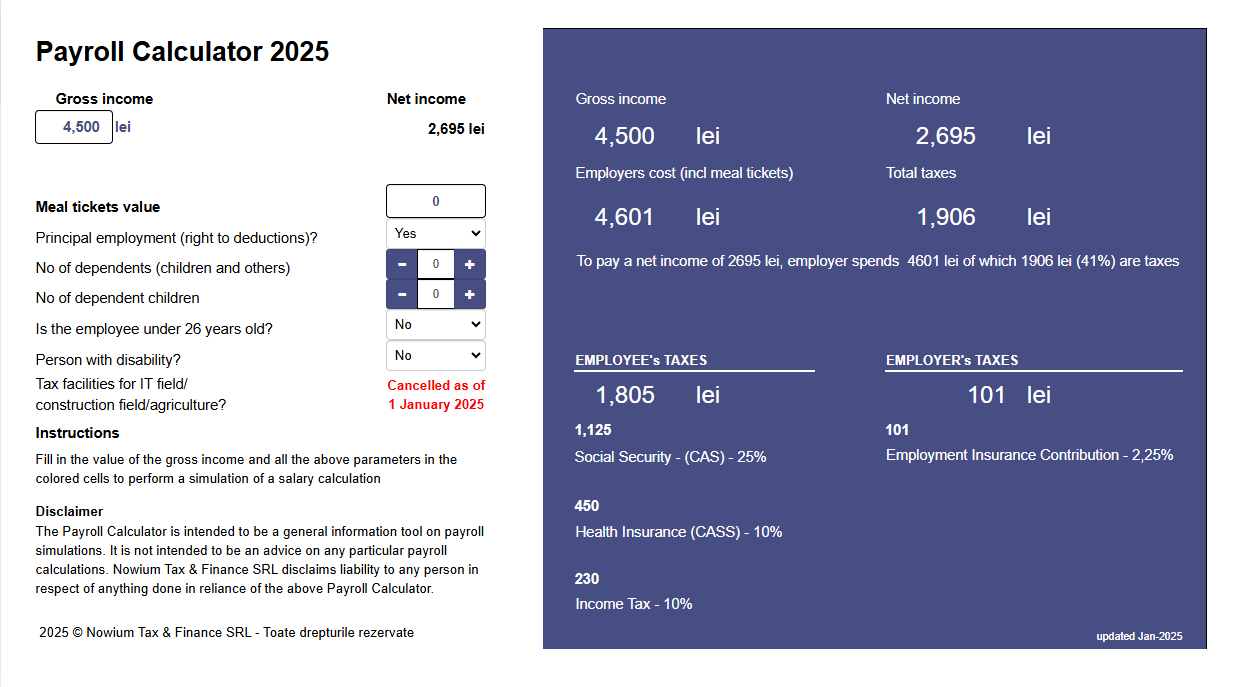
Check out our Payroll Calculator Tool on Nowium’s website
An useful free tool allowing various salary calculation scenarios, updated with the latest legislative changes. https://nowium.com/en/payroll-calculator/
Order 1421/2025 on the dates from which certain sustainability reporting requirements apply (Official Gazette 786/2025)
Summary
The order postpones by two years the application of sustainability reporting requirements for certain types of entities.
Details
The implementation deadline for sustainability reporting requirements is postponed by two years for certain types of entities:
- Medium-sized and large entities that are not public-interest entities, as well as entities that are parent companies of a large group, without being public-interest entities: the first sustainability report will have to be prepared for the financial year starting on the 1st of January 2027.
- Entities whose securities are admitted to trading on a regulated market, which do not exceed the size criteria for classification as medium-sized and large entities: the first sustainability report will have to be prepared for the financial year starting on the 1st of January 2028.
As a reminder, Romania has transposed into domestic law the European regulations on sustainability reporting through Order 85/2024 (Official Gazette 75/2024). This refers to Directive (EU) 2025/794 of the European Parliament and the Council, 14 April 2025, amending Directives (EU) 2022/2464 and (EU) 2024/1760 on the dates from which Member States are to apply certain sustainability reporting and due diligence requirements for companies.
We emphasize that Order 1421/2025 does not apply to entities whose sustainability reporting obligations began with the financial year starting on the 1st of January 2024, namely:
- Medium-sized and large public-interest entities that, on balance sheet date, exceed the average headcount of 500 employees during the financial year.
- Public-interest entities that are parent companies of a large group, which, on the balance sheet date, on a consolidated basis, exceed the average headcount of 500 employees during the financial year.
These entities will continue to prepare sustainability reports.
Order 1194/2025 to approve Accounting report system for economic operators as at 30 June 2025 (Official Gazette 730/2025).
Summary
The Order approves Accounting report system for economic operators as at 30 June 2025.
Details
The accounting report system for economic operators as at 30 June 2025 applies to:
1. Entities applying national accounting regulations (OMPF 1802/2014) and which, during the previous financial year, registered a net turnover above EUR 1,000,000 in RON.
Entities prepare and submit to territorial units of the Ministry of Finance the accounting reports as of the 30th of June 2025 containing the following forms:
- Statement of assets, liabilities and equity (code 10);
- Income statement (code 20), or Abbreviated income statement (code 20);
- Informative data (code 30).
2. Entities applying Accounting regulations according to IFRS (OMPF 2844/2016) and which, during the previous financial year, registered a net turnover above EUR 1,000,000 in RON.
Entities prepare and submit to territorial units of the Ministry of Finance the accounting reports as of the 30th of June 2025 containing the following forms:
- Statement of assets, liabilities and equity (code 10);
- Income statement (code 20);
- Informative data (code 30).
Provisions also apply to economic operators that have opted for a different financial year than the calendar year.
Qualification within the turnover limit is made based on the indicators determined from the annual financial statements of the previous financial year, respectively the trial balance concluded at the end of the previous financial year, using the exchange rate communicated by NBR, valid on the date of the conclusion of the previous financial year.
The provisions also apply to subunits in Romania belonging to legal entities headquartered abroad, as well as to permanent establishments in Romania belonging to legal entities headquartered abroad, regardless of the financial year chosen, according to law. Foreign legal entities that have their place of effective management in Romania are not subject to accounting reporting as of the 30th of June 2025.
Do not prepare accounting reports on the 30th of June 2025:
- Entities that do not carry out activity from set-up date by the 30th of June 2025
- Entities that during the entire first half of 2025 were in temporary inactivity
- Entities established during 2025
- Legal entities in liquidation.
Submission deadline: the 18th of August 2025.
Offences:
- failure to comply with provisions on preparation and signature of accounting reports is sanctioned with a fine between RON 2,000 and RON 3,000;
- failure to comply with provisions on submission of accounting reports within the legal deadline, if the delay period is between:
- 1 and 15 working days, is sanctioned with a fine between RON 300 to RON 1,000;
- 16 and 30 working days, is sanctioned with a fine between RON 1,000 to RON 3,000;
- exceeds 30 working days, is sanctioned with a fine between RON 1,500 to RON 4,500.
Order 248/1377/2066/3103/2025 to approve template, content, means to submit and administer/manage for 112, Tax Return on social contributions, income tax and nominative list of insured persons (Official Gazette 800/2025)
The Order updates template and instructions to fill form 112 Tax Return on social contributions, income tax and nominative list of insured persons.
Closing exchange rates for August 2025
The August 2025 closing NBR exchange rates to use for valuation of monetary items (cash on hand, receivables, payables) denominated in foreign currency, as well as receivables and payables denominated in RON but pegged to a foreign currency for collection/disbursement are:
1 EUR = 5,0722 RON; 1 USD = 4,3443 RON; 1 CHF = 5,4228 RON; 1 GBP = 5,8500 RON
The Resources section of our website has an Excel file through which exchange rates are automatically taken from the NBR website and are allocated on each date of validity, according to accounting rules. Thus, the exchange rate communicated by NBR on day N will be displayed on the validity dates N+1…N+2….until the next foreign exchange session.
The closing exchange rate for the month is the exchange rate communicated in the final foreign exchange session of the respective month.
Social Indicators 2025
2025 Contributions - for dependent activities | Employer and beneficiary (for activities considered dependent) | Employee and dependent worker |
Social security contribution (pension) | - Nothing due for normal working conditions | 25% |
Contribution to health insurance fund (calculated on gross income) | Not due | 10% |
Income Tax | 10% | |
Work insurance contribution | 2,25% | |
Disability Fund (for employers with more than 50 employees) | 4 x minimum wage for every 100 employees | |
The amount of a taxable meal ticket in the sense of income tax | max. RON 40.04 | |
Minimum wage (gross) | -> RON 4.050 (starting with January 2025 related income) -> RON 4.582 for employees from construction sector -> RON 4.050 for agriculture and food industry sectors (starting with January 2025 related income) | |
Per Diem (in the country) | 23 lei 57.5 lei | |
The tax facilities granted to employees working in the IT sector, construction, agriculture and the food industry have been eliminated starting with the income related to January 2025. | ||