Newsletter no. 5 – May 2025

Access the magazine version of this Newsletter in pdf format: English or Romanian
Summary
- New access procedure for the REGES-ONLINE platform (Order 1107/2025)
- Updated forms D100 and D710 to declare tax on construction (Order 649/2025)
- Updated Procedure to grant instalment payments (Order 597/2025)
- Procedure and conditions to transmit information on foreign legal entities carrying out operations in oil and natural gas sectors, between the Romanian Customs Authority (AVR) and ANAF (Order 689/2025)
- Amendments to legislation on prevention and combat of money laundering and terrorist financing (Law 86/2025)
- Other legislative developments
- May 2025 closing exchange rates
- Social indicators
Assess your team’s readiness for fiscal challenges
Answer 10 questions in less than 3 minutes and find out how well your accounting team is coping with legislative changes!
✔️ Is your team up to date with all fiscal news?
✔️ What hidden risks may arise from the lack of continuous updating?
✔️ How can you transform uncertainty into efficiency and fiscal security?
Complete the quiz and get a clear picture of your team’s level of training – an essential resource in any company!
👉 In an ever-changing fiscal environment, constant training is no longer optional, but a competitive advantage!
https://start.infrared.global/taxgroup
Order 1107/2025 to approve Access Procedure to prepare, transmit and query data in/from the General Staff Register – REGES-ONLINE (Official Gazette 430/2025)
Summary
The Ministry of Labor adopted Order 1107/2025, which establishes the new access procedure for REGES-ONLINE platform – the IT system that will replace the local Revisal application used so far by employers.
Details
The REGES-ONLINE platform marks an important step in the digitalization of employment relations, allowing the transmission and management of data from the General Staff Register (REVISAL) in a centralized, secure and completely online manner.
The order details:
- Categories of users who may access REGES-ONLINE (employers, service providers, public institutions, etc.);
- Method to register and authorize users, including their designation in the system and assignment of access levels;
- Types of electronic signature accepted;
- Rules on modification, suspension or withdrawal of access;
- Clarification on mode of operation, responsibilities of entities involved and interaction with territorial labor inspectorates.
More details about REGES-ONLINE may be found in the article published on our website: read the full article about REGES-ONLINE and Order 1107/2025 .
How much time does your company’s payroll really take?
Find out if your current payroll system gives you the control and peace of mind you need in 3 minutes.
As an entrepreneur or executive, you know that payroll may quickly become a burden that takes valuable time. But how efficient is your current system really?
Self-assess your system and find out:
- What is your actual level of exposure to an ITM (Territorial Work Inspectorate) audit?
- How many hours may you save monthly by optimizing payroll?
- How does your system compare to market best practices?
https://start.infrared.global/nowium
How much time does your company’s payroll really take?
Find out if your current payroll system gives you the control and peace of mind you need in 3 minutes.
As an entrepreneur or executive, you know that payroll may quickly become a burden that takes valuable time. But how efficient is your current system really?
Self-assess your system and find out:
- What is your actual level of exposure to an ITM (Territorial Work Inspectorate) audit?
- How many hours may you save monthly by optimizing payroll?
- How does your system compare to market best practices?
https://start.infrared.global/nowium
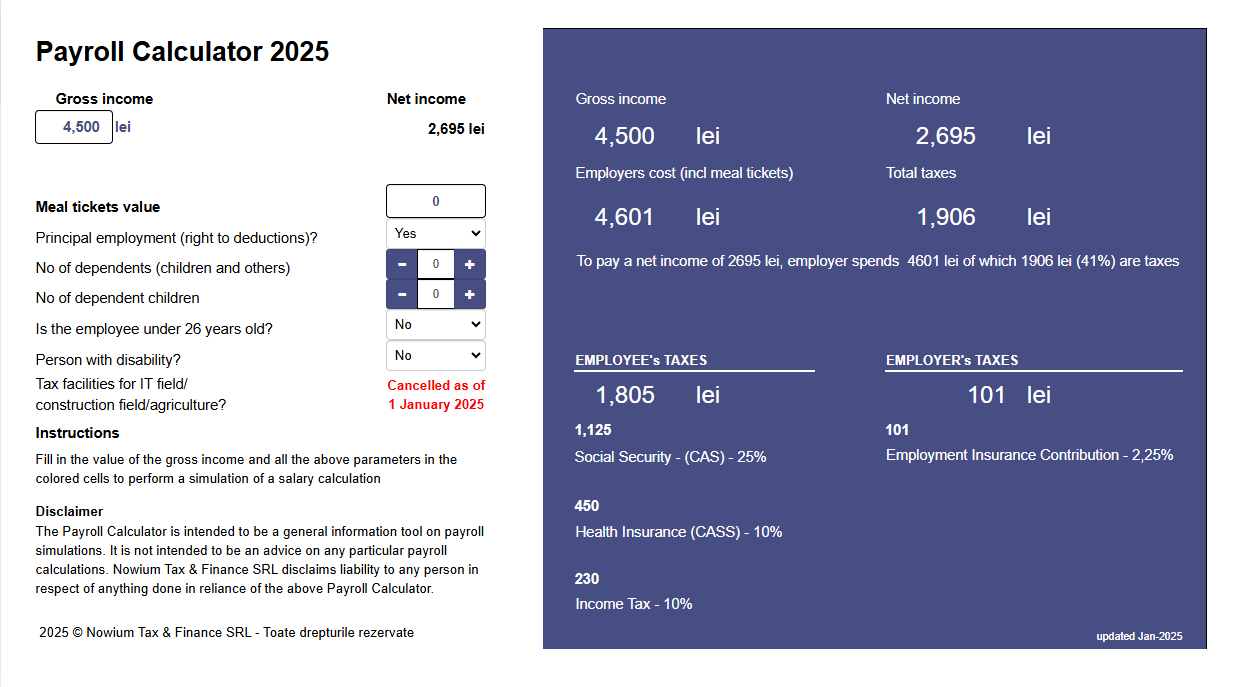
Check out our Payroll Calculator Tool on Nowium’s website
An useful free tool allowing various salary calculation scenarios, updated with the latest legislative changes. https://nowium.com/en/payroll-calculator/
Order 649/2025 to amend and complement ANAF Presidential Order 587/2016 to approve template and content of forms used to declare taxes and fees for self-taxation or withholding tax regime (Official Gazette 453/2025)
Summary
The order updates forms D100 and D710 to declare tax on construction.
Details
The Order amends ANAF Presidential Order 587/2016 to approve template and content of forms used to declare taxes and fees for self-taxation or withholding tax regime, amendments necessary to report tax on construction, re-introduced starting the 1st of January 2025, and the bonus granted for early payment.
Thus, the main amendments brought by the Order are:
a) complementing template and content of forms 100 – Statement on payment obligations towards the State Budget and 710 – Adjusting tax return, in order to highlight the bonus granted according to conditions provided by art. 499 para. (4^1) of the Fiscal Code.
b) appropriate amendment to the instructions to file form 100.
The tax on construction (code 701) with/without bonus is declared entirely on form D100, by the 25th of the fifth month of the fiscal year. Exceptions are newly established taxpayers or those that are in the process of liquidation. The declaration of tax is made differently, depending on whether the full advance payment, which implies obtaining the bonus or paying in instalments. The bonus is reported separately on the form.
How solid is your business model when it comes to transfer pricing rules?
Find out in just 3 minutes if your business model complies with legal requirements for related-party transactions and how exposed you are to tax risks!
✔️ Are you required to prepare a transfer pricing file?
✔️ What are your chances of being selected for an audit?
✔️ How do you compare to the best market practices?
Complete the quick questionnaire and get a clear self-assessment of your compliance level.
👉 Don’t leave compliance to chance. Protect your company, avoid fines and costly adjustments!
https://start.infrared.global/preturidetransfer
Order 597/2025 to amend and complement annexes no. 1 and 2 to ANAF Presidential Order 90/2016 for approval of content of request to grant rescheduled/instalment payments and the attached supporting documents, as well as Procedure for applying rescheduled/instalment payments by the central fiscal body and to amend and complement the annex to ANAF Presidential Order 1767/2021 for approval of Procedure to grant rescheduled/instalment payment, in simplified form, by the central fiscal body (Official Gazette 439/2025)
Summary
The Order updates application procedure to grant instalment payments in classic and simplified form as a result of legislative amendments.
Details
We mention the most important news:
Instalment payments in classic form:
Annex no. 1, Content of the application to grant instalment payments and supporting documents and Annex no. 2, Procedure to apply for the grant of instalment payments by the central fiscal body, approved by OPANAF 90/2016, which regulates the following aspects, are amended and complemented:
1. updating and improving the application template to grant instalment payments;
2. reviewing the supporting documents that are attached to this application, in order to reduce the number of documents submitted by taxpayers, so that the transmission of the application by electronic means of remote transmission (SPV) is easier;
3. updating the procedure to grant payment facilities through:
- establishing the competence to grant payment facilities to individuals who carry out economic activities independently or exercise liberal professions, by fiscal authorities that administer/manage the fiscal obligations owed by them;
- eliminating the debtor’s obligation to submit certain documents, such as: annual financial statement, statement of cash receipts and payments for the last 6 months prior to submission date of the application to grant instalment payments, as well as the situation regarding indicative indicators and other information. In fact, to determine the situation of difficulty caused by the temporary lack of cash availability and payment capacity during the debtor’s installment period, the fiscal authorities will analyze, based on the information they hold, the cash available in the debtors’ bank accounts, as well as the income earned by individuals;
- maintaining the competence of the fiscal authorities under the subordination of ANAF to grant payment facilities for customs claims established by the customs authorities through adjustment decisions and forwarded for recovery through enforcement to the fiscal authorities, following clarifications provided by the General Customs Authority (AVR) via address no. 25274/09.10.2023;
- provisions on granting instalment payments in the case of debtors that provide warranties less than or higher than 50% of the outstanding fiscal obligations that are subject to instalment payments;
- updating provisions on checking conditions to grant/change/maintain the instalment payments provided in the content of reports “A” and “B”;
- provisions to not include in the decision a change in instalment payments for fiscal obligations for which installment payments are not granted;
- provisions to reduce the number of applications to change instalment payments and to maintain the validity of the payment schedule, from two applications to a single one throughout a calendar year or fraction of a calendar year;
- repeal of provisions to approve another instalment payment period in the event of a change in the instalment payment decision;
4. procedure to grant instalment payments for debtors that are in insolvency;
5. updating templates of the forms provided for in the procedure to grant payment facilities;
6. introduction of a new form regarding the agreement to analyze an exit from the insolvency procedure.
Instalment Payments in simplified form:
The Annex Procedure to grant instalment payments, in simplified form, by the central fiscal body, approved by ANAF Presidential Order 1767/2021, is amended and complemented, regulating the following aspects:
1. maintaining the competence of the fiscal authorities subordinate to ANAF to grant payment facilities for customs claims established by the customs authorities through adjustment decisions on the situation and transmitted for recovery through forced execution by fiscal authorities, for the same reasons as those provided for classic instalment payments;
2. eliminating provisions on granting instalment payments, in a simplified form, for debtors provided by art. 204 of the Fiscal Procedure Code, namely those that should pay the fiscal obligations administered/managed by the central fiscal body within a certain period in order to maintain the authorization, agreement or other similar administrative act;
3. provisions to reduce the number of applications to change instalment payments and to maintain its validity, from two requests to a single application during the validity period of the instalment payments schedule;
4. repeal of provisions to approve another instalment payment period in the event of a change of the instalment payment decision;
5. repeal of provisions regarding the waiver of the intention to benefit from restructuring of budgetary obligations in cases where notifications have been submitted according to GO 6/2019, with its subsequent amendments and complements;
6. updating templates of forms provided by the procedure to grant instalment payments, in a simplified form.
7. introduction of a new form regarding the agreement in principle in the case of change/maintaining the validity of instalment payments for debtors that should pay fiscal obligations administered/managed by the central fiscal authority within a certain period in order to maintain the authorization, agreement, or other similar administrative act, according to provisions of art. 2, para. (2) of GO 31/2022, for the purpose of establishing the warranty provided by law.
Tax Group
🔥 New! The Tax Group platform has been completely redesigned! With a modern look, new features, and an improved user experience, accessing essential information is now easier than ever.
🔹 Stay up to date with the latest tax news! 🔹
Tax legislation is constantly changing, and the right decisions depend on accurate, up-to-date information. Tax Group gives you monthly access to key legislative updates and expert analysis.
📌 Join now and explore the new platform!
🔗 Visit www.taxgroup.ro to watch a teaser of a Tax Group event and discover the benefits of a professional subscription!

Order 689/2025 to approve the Procedure and conditions to transmit information provided by art. 46^2 para. (22) of Law 227/2015 on the Fiscal Code (Official Gazette 503/2025)
Summary
The Order approves procedure and conditions to transmit information provided by art. 46² para. (22) of the Fiscal Code on foreign legal entities carrying out operations in oil and natural gas sectors.
Details
The main provisions:
- Institutional cooperation: The Romanian Customs Authority (AVR) and ANAF will exchange information within a maximum of 3 working days regarding legal entities involved in customs operations in these sectors, including data on the establishment and execution of mandatory fiscal warranties.
- Operative transmission of data: Single points of contact are established between the two institutions for electronic transmission of information, for prompt application of fiscal and customs regulations.
- Fiscal warranties: If a legal entity does not establish or does not replenish the warranty provided by the Fiscal Code, ANAF promptly informs AVR in order to prohibit customs formalities. The resumption of operations is allowed only after confirmation of the establishment of the warranty.
- Monitoring of deliveries: AVR will transmit to ANAF data on the quantities and values related to intra-community deliveries and customs operations carried out by the legal entities concerned on a monthly basis, no later than the 15th of the subsequent month.
This procedure aims to strengthen fiscal and customs control over activities in oil and natural gas sectors, through an efficient exchange of data between responsible institutions.
Law 86/2025 to amend and complement Law 129/2019 to prevent and combat money laundering and terrorist financing, as well as to amend and complement certain normative acts (Official Gazette 483/2025)
Numerous amendments are brought to provisions of Law 129/2019 to prevent and combat money laundering and terrorist financing.
We present the main changes below.
1. Expanding bans on anonymous products
- Art. 10 para. (1): The provision of products to persons using fictitious names is prohibited, in addition to the already prohibited anonymous accounts, passbooks, or safe deposit boxes.
2. Clarification on Publicly Exposed Persons (PEPs)
- Art. 3 para. (6): Extension of the period during which a person is considered a PEP by 1 additional year if the associated risk persists due to a previously held position.
- Art. 17 para. (13) letter c): The obligation to report suspicious transactions is introduced if a publicly exposed person is the beneficiary of a life insurance policy and there are suspicions.
3. New obligations for exchange offices and crypto-asset service providers
- Art. 13: Introduction of thresholds to apply know your customer (KYC) measures:
- EUR 2,000 for exchange offices.
- EUR 1,000 for crypto-asset service providers.
4. Clarification on UBO data and access to registers
- Free access is restricted: now only individuals or legal entities with a legitimate interest may access the registers (Art. 19 para. (8), (81), (82)).
- Access is revoked for any individual who just “submits a written application” (letter d) of para. (81)).
5. Additional obligations for reporting entities
- Simplified KYC measures in case of suspicion will no longer be applied (Art. 16 para. (5)).
- The obligation to request information about the actual headquarters, not just the registered office (Art. 15 para. (11)).
6. Regulations for associations and foundations
- The Office will supervise their activity based on a risk-based approach, including the identification of those vulnerable to terrorist financing (Art. 261).
- Obligations of financial transparency and cooperation with the Office are imposed.
7. Consolidation of inter-institutional collaboration
- Criminal prosecution bodies should provide feedback to the Office on information received and measures adopted (Art. 34 para. (81)-(82)).
8. Rules on the retention and exchange of information
- Art. 21: Supporting documents should be kept for 5 years.
- Art. 38 para. (5): The exchange of information between entities under certain conditions does not constitute a breach of professional secrecy.
9. New sanctions
- Introduction of new contraventions: failure to comply with data transmission obligations by associations and foundations (Art. 43 para. (1) letter j)).
- Sanction: warning or fine between RON 10,000 and RON 90,000.
Other legislative developments
Order 623/2025 to amend ANAF Presidential Order 587/2016 to approve template and content of forms used to declare taxes and fees for self-taxation or withholding tax regimes (Official Gazette 436/2025)
The Order amends ANAF Presidential Order 587/2016, as follows:
- amending the List of payment obligations towards State Budget for the purpose of declaring the mentioned tax obligations, by updating the legal basis related to position 87, “Contribution to the Energy Transition Fund;”
- appropriate amendment of instructions to fill form 100.
The provisions apply to obligations due as of the 1st of April 2025.
Order 2/2025 to amend and complement NBR Order 2/2020 approving Methodological Norms on the preparation of annual accounting reporting for information needs of the Ministry of Public Finance, applicable to credit institutions (Office Gazette 478/2025)
Order 3/2025 to amend and complement NBR Order 3/2024 approving Methodological Norms on the preparation of annual accounting reporting for information needs of the Ministry of Finance, applicable to non-banking financial institutions (Official Gazette 478/2025)
Closing exchange rates for May 2025
The May 2025 closing NBR exchange rates to use for valuation of monetary items (cash on hand, receivables, payables) denominated in foreign currency, as well as receivables and payables denominated in RON but pegged to a foreign currency for collection/disbursement are:
1 EUR = 5.0639 RON; 1 USD = 4.4699 RON; 1 CHF = 5.4252 RON; 1 GBP = 6.0206 RON
The Resources section of our website has an Excel file through which the exchange rates are automatically taken from the NBR website and are allocated on each date of validity, according to accounting rules. Thus, the exchange rate communicated by NBR on day N will be displayed on the validity dates N+1…N+2….until the next foreign exchange session.
The closing exchange rate for the month is the exchange rate communicated in the final foreign exchange session of the respective month.
Social Indicators 2025
2025 Contributions - for dependent activities | Employer and beneficiary (for activities considered dependent) | Employee and dependent worker |
Social security contribution (pension) | - Nothing due for normal working conditions | 25% |
Contribution to health insurance fund (calculated on gross income) | Not due | 10% |
Income Tax | 10% | |
Work insurance contribution | 2,25% | |
Disability Fund (for employers with more than 50 employees) | 4 x minimum wage for every 100 employees | |
The amount of a taxable meal ticket in the sense of income tax | max. RON 40.04 | |
Minimum wage (gross) | -> RON 4.050 (starting with January 2025 related income) -> RON 4.582 for employees from construction sector -> RON 4.050 for agriculture and food industry sectors (starting with January 2025 related income) | |
Per Diem (in the country) | 23 lei 57.5 lei | |
The tax facilities granted to employees working in the IT sector, construction, agriculture and the food industry have been eliminated starting with the income related to January 2025. | ||